


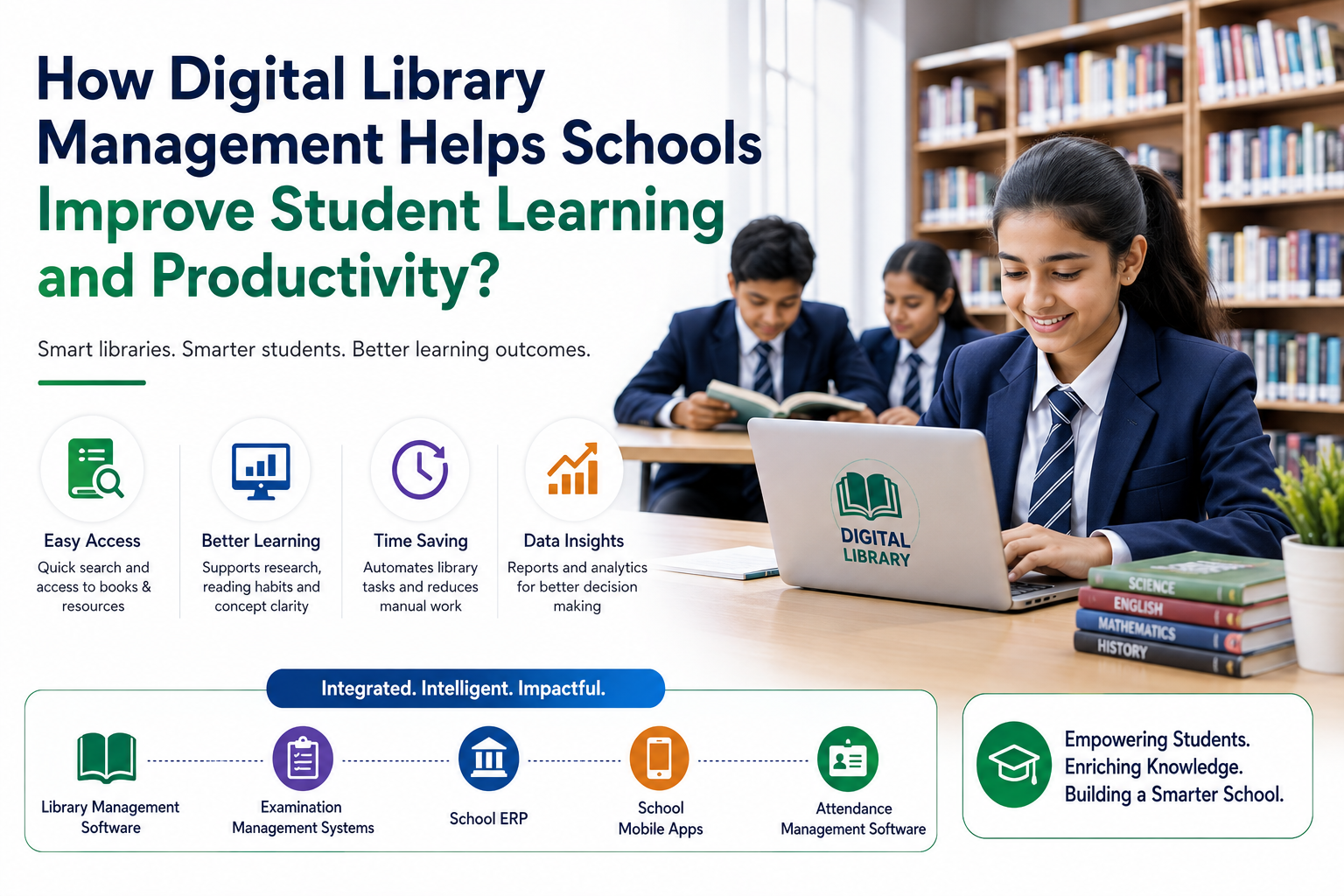
Schools are rapidly adopting digital technologies to create more organized, engaging, and student-focused learning environments. While classrooms and online learning platforms receive much attention, the school library remains an important part of academic development. A well-managed library gives students access to knowledge, encourages independent learning, and supports better research habits. However, managing books and resources manually can make library operations slow and difficult to track.
This is where digital library management can make a significant difference. Modern Library Management Software helps schools automate daily library activities, improve access to educational resources, and provide students with a smoother learning experience. When connected with Examination Management Systems, School ERP, School Mobile Apps, and Attendance Management Software, digital library management can become an important part of a connected school ecosystem.
What Is Digital Library Management?
Digital library management refers to using software to manage a school's physical and digital learning resources. Instead of relying on registers and spreadsheets, librarians can use a centralized platform to manage books, student records, borrowing activities, returns, reservations, and inventory.
A modern Library Management Software can help schools:
-
Maintain digital book catalogs
-
Track issued and returned books
-
Manage student borrowing records
- Manage digital learning materials
-
Improve communication with students and teachers
By automating repetitive tasks, schools can reduce administrative work and focus more attention on supporting student learning.
How Digital Libraries Improve Student Learning
1. Give Students Faster Access to Learning Resources:
Students often need additional resources beyond textbooks to understand a subject properly. A digital library makes it easier for them to discover books, reference materials, research content, and other educational resources.
Instead of spending several minutes searching through shelves, students can search the digital catalog using a book title, author, subject, or category.
Faster access means students can spend more time reading, researching, and completing academic work. This can encourage independent learning and help students develop stronger study habits.
2. Encourage Better Reading Habits:
Regular reading helps students improve vocabulary, comprehension, communication, and critical-thinking abilities.
Library Management Software allows schools to make reading more convenient and engaging. Students can view available resources, check book details, reserve books, and monitor their borrowing history.
Schools can also use library data to understand which subjects and resources students prefer. Based on this information, librarians can introduce relevant books and create reading programs that encourage greater participation.
3. Support Research-Based Learning:
Modern education increasingly focuses on research, projects, presentations, and practical assignments. Students need reliable resources to explore topics beyond classroom lessons.
A digital library provides a structured way to access relevant materials. Teachers can recommend specific resources for assignments, while students can independently search for additional information.
This approach encourages students to ask questions, explore different perspectives, and develop research skills that are useful throughout their academic journey.
Connecting Library Management With Examination Management Systems
Academic performance is not determined by library usage alone, but library resources can support examination preparation.
When Library Management Software works alongside Examination Management Systems, schools can create a stronger academic support environment.
For example, students preparing for examinations can quickly identify subject-specific books, reference materials, and practice resources. Teachers can also recommend additional reading based on upcoming examinations.
Schools can use academic and library data to understand which learning resources are being used most frequently during examination periods. This can help administrators make better decisions about purchasing books and expanding educational resources.
Integration With School ERP
A School ERP brings multiple school operations together within a centralized platform. Integrating library management with an ERP can eliminate disconnected processes and improve information flow.
A connected system can bring together:
-
Student information
-
Attendance records
-
Examination results
-
Library activities
-
Academic information
This gives administrators a broader view of student activities and school operations.
For example, teachers and administrators can access relevant student information without maintaining separate records for every department. This reduces duplicate data entry and improves operational efficiency.
Improving Accessibility Through School Mobile Apps
Students and parents increasingly expect schools to provide information through mobile devices. School Mobile Apps can extend library services beyond the physical library.
Through a mobile application, students may be able to:
-
Search for books
-
Check availability
-
View borrowing history
-
Receive return reminders
-
Access selected digital resources
This convenience allows students to interact with library services from home or while traveling.
For parents, mobile notifications can provide greater visibility into student activities and encourage children to develop consistent reading habits.
Connecting Library Usage With Attendance
Student participation is another important part of academic success. Integrating library systems with Attendance Management Software can provide schools with useful insights.
Administrators may identify patterns between attendance, library participation, and academic engagement. If a student regularly attends school but rarely uses available learning resources, teachers may be able to encourage additional reading or research activities.
Similarly, students with frequent absences may require additional academic support and access to digital resources outside normal classroom hours.
The goal is not simply to monitor students but to use information to provide timely and meaningful support.
How Digital Library Management Improves School Productivity?
The benefits of digital library management extend beyond students.
For librarians, automation reduces the time required to maintain records, track books, and prepare reports. Teachers can find resources faster, while administrators gain access to useful data for decision-making.
Digital systems also reduce the possibility of errors associated with manual records.
Instead of spending hours managing paperwork, staff can focus on activities that create greater value, such as organizing reading programs, supporting students, and improving library resources.
Benefits for Students and Schools
A modern digital library can deliver several advantages.
For Students
-
Faster access to educational resources
-
Better reading habits
-
Convenient mobile access
-
Better examination preparation
For Schools
-
Reduced administrative workload
-
Improved resource management
-
Better reporting and analytics
-
More efficient school operations
These benefits make digital library management an important part of modern educational technology.
The Future of Digital School Libraries
School libraries are likely to become increasingly connected with broader digital learning ecosystems. Artificial intelligence, personalized recommendations, cloud-based platforms, and mobile technologies can make educational resources more accessible.
Future Library Management Software may help recommend resources based on student interests, academic requirements, and reading behavior. Integration with School ERP platforms and School Mobile Apps can further connect libraries with classrooms, examinations, attendance, and parent communication.
This evolution can transform the traditional library from a place where students simply borrow books into an intelligent learning center.
Conclusion
Digital library management is changing how schools organize resources and support student learning. With Library Management Software, students can find educational materials faster, develop stronger reading habits, and conduct research more effectively.
Integration with Examination Management Systems, School ERP, School Mobile Apps, and Attendance Management Software creates a connected environment where academic and administrative information can work together.
For schools, the result is greater productivity, improved resource utilization, and more efficient operations. For students, it means easier access to knowledge and stronger support throughout their academic journey. As education continues to become more digital, a smart library can play an increasingly important role in creating productive, engaged, and successful learners.

 English
 Arabic
 French
 Spanish
 Portuguese
 Turkish
 Dutch
Dutch
 Italiano
 Russian
 Romaian
 Portuguese (Brazil)
 Greek
Greek