


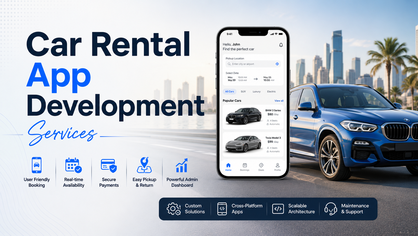
The car rental industry is moving beyond simple reservation systems. Car rental app development is becoming a strategic investment for rental companies, fleet operators, mobility startups, and travel businesses that want to deliver faster bookings while improving control over their vehicle assets. In 2026, mobile-first booking, contactless rentals, digital contracts, fleet management, and connected-vehicle technologies are reshaping how rental businesses operate.
For businesses, the opportunity is not simply to put a booking form inside an app. The real value comes from building a connected platform that links customers, vehicles, payments, operations, and business intelligence. When these functions work together, rental companies can reduce manual processes, improve fleet utilization, and create a more convenient customer journey.
Car Rental App Features Driving Industry Growth
Modern rental platforms need to support the complete rental lifecycle. Customers should be able to search available vehicles, compare models, view pricing, select rental periods, upload required documents, make secure payments, receive booking confirmation, and manage their reservations from one application.
For operators, the backend should provide real-time fleet visibility. Vehicle availability, booking schedules, maintenance status, location, utilization, and revenue can be managed through a centralized dashboard. This is particularly important as fleets expand across multiple locations.
Contactless rental is another important market trend. Digital agreements, mobile check-in, identity verification, and digital key integration can reduce dependency on physical paperwork and make vehicle collection more convenient. Advanced platforms can also integrate telematics to monitor vehicle location, usage, and condition.
The shift toward flexible rental models is also creating new opportunities. Instead of relying exclusively on daily rentals, businesses can introduce weekly packages, monthly subscriptions, corporate plans, and other recurring mobility offerings. In India, market research points to growing app-based booking adoption alongside subscription and flexible rental models.
Solving Fleet Utilization and Operational Challenges
One of the biggest challenges in the rental industry is maximizing the value of every vehicle. An underutilized car still creates costs through financing, depreciation, insurance, parking, and maintenance. A technology platform can help businesses make better decisions about where vehicles should be positioned, when they require maintenance, and which rental models can improve utilization.
Data-driven fleet management is therefore becoming a competitive advantage. Analytics can reveal booking patterns, popular vehicle categories, demand by location, cancellation trends, utilization rates, and revenue performance. Predictive maintenance can also help operators identify potential vehicle issues before they become costly disruptions.
AI is adding another layer of intelligence. Rental platforms can use customer and market data to personalize vehicle recommendations, support demand forecasting, and optimize pricing strategies. Meanwhile, EV integration is creating additional requirements, such as battery-range information and charging-location support.
Building a Scalable Digital Rental Platform
Scalability should be considered from the beginning of the development process. A platform designed only for a small fleet can become difficult to manage when the business adds vehicles, locations, customers, partners, and new rental categories.
A future-ready architecture should support multiple vehicle types, location-based inventory, dynamic pricing, corporate accounts, subscriptions, promotions, multilingual interfaces, multiple currencies, secure payment gateways, and third-party integrations.
There is also an emerging opportunity around AI-driven travel and booking experiences. Rental inventory increasingly needs to be structured around accurate availability, pricing, pickup rules, vehicle information, and booking conditions so that new digital discovery channels can connect customers with real inventory.
Security is equally important. Customer identity documents, payment information, rental agreements, and vehicle data require appropriate safeguards. Strong authentication, secure APIs, encrypted transactions, role-based administration, and reliable audit trails should be part of the platform strategy.
Why Invest in Car Rental App Development Now?
The competitive landscape is shifting from simply owning more vehicles to managing fleet assets more intelligently. Rental businesses that combine digital booking with real-time fleet intelligence can respond faster to market demand while creating stronger customer relationships.
A successful car rental platform should therefore be more than a mobile storefront. It should function as a digital operating system for the rental business—connecting customer acquisition, reservations, fleet utilization, payments, maintenance, analytics, and growth.
For startups, established rental companies, fleet owners, and mobility businesses, SpotnRides can help transform this strategy into a scalable digital platform tailored to specific business models and market requirements.

 English
 Arabic
 Spanish
 Portuguese
 Deutsch
 Turkish
 Dutch
 Italiano
 Russian
 Romaian
 Portuguese (Brazil)
 Greek