


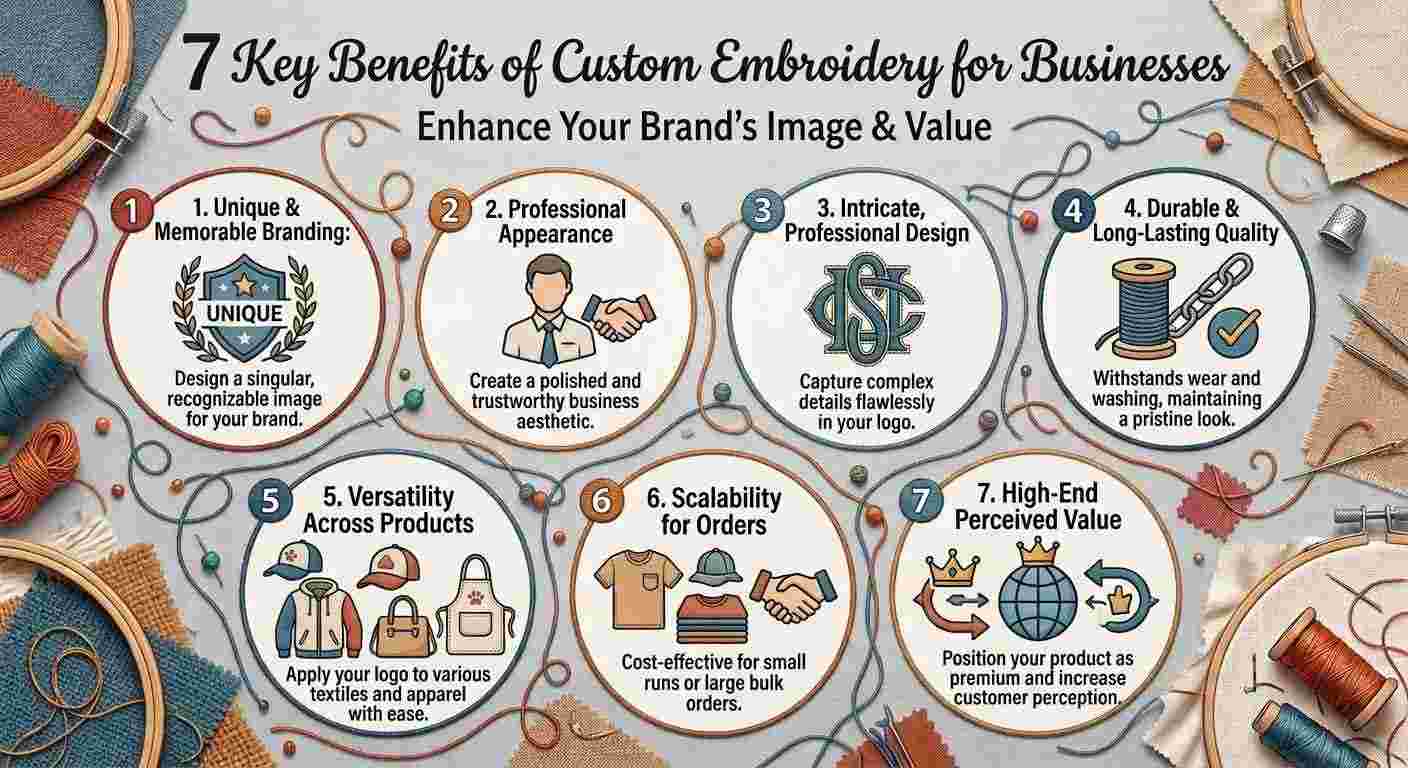
Businesses, clothing brands, organizations, and individuals often need embroidery designs that balance appearance, quality, and production costs. Choosing an affordable custom embroidery pattern can provide a practical way to prepare logos, names, artwork, and other designs for machine embroidery without adding unnecessary complexity. The right pattern can be adapted to different garments and products while keeping factors such as stitch count, colors, size, and fabric requirements in consideration.
Affordability does not simply mean selecting the lowest-priced option. A useful embroidery pattern should be technically appropriate, readable at its intended size, compatible with the required machine format, and suitable for the fabric being used. When these factors are considered together, an economical pattern can support both small orders and ongoing production needs.
1. Helps Control Overall Embroidery Costs
One of the clearest benefits is better control over production expenses. Embroidery costs can be influenced by design complexity, stitch count, thread changes, size, and the type of product being embroidered.
A carefully prepared pattern can remove unnecessary details while preserving the important elements of the artwork. For example, a logo containing multiple tiny shapes may be simplified for a small shirt placement. This can reduce unnecessary stitching while making the finished design easier to reproduce.
However, cost reduction should not involve removing so much detail that the logo loses its meaning. A good pattern balances efficient production with suitable visual quality.
For businesses ordering multiple garments, even small improvements in design efficiency can be useful when the same pattern is produced repeatedly.
2. Provides Flexible Branding Options
A custom embroidery pattern can be adapted for a variety of business products. The same core logo can be prepared for shirts, jackets, caps, bags, uniforms, patches, and other suitable items.
For instance, a company may use a larger version of its logo on the back of a jacket and a smaller version on the left chest of a polo shirt. A simplified version may be more appropriate for a cap where the available embroidery area is limited.
This flexibility allows businesses to maintain consistent branding while adapting the design to different products.
Rather than creating completely unrelated artwork for every item, businesses can use a coordinated set of embroidery files based on the same brand identity.
3. Makes Custom Designs More Accessible
Professional custom embroidery does not have to involve an unnecessarily complicated design. An affordable pattern can make personalized embroidery practical for small businesses, startups, clubs, teams, and individuals working with limited budgets.
A simple monogram, business logo, name, icon, or short phrase can often provide an effective embroidery design when it is prepared correctly.
For example, a small service business may need embroidered work shirts for a team of five employees. Instead of using a large, highly detailed design, the business can choose a compact logo with the company name. This may be easier to reproduce consistently across the garments.
The important factor is selecting a pattern that matches the actual purpose rather than adding design elements that do not contribute to the finished product.
4. Supports Better Production Planning
An affordable custom pattern can also make production planning easier because the design requirements are known before embroidery begins.
The final file can specify the intended size, stitch structure, colors, and machine format. When these details are organized, the embroidery provider can better understand what is required for production.
Businesses can also keep approved embroidery files for future orders. If additional uniforms are needed several months later, the existing design can be reused instead of beginning the artwork process again.
Maintaining organized files is particularly useful when a company has multiple logo versions. Clear file names can identify whether a design is intended for a cap, shirt, jacket, patch, or another product.
5. Allows Designs to Be Optimized for Different Fabrics
An embroidery pattern should not be treated as a universal file that performs identically on every material. Fabric characteristics can affect how stitches behave.
Cotton, denim, fleece, canvas, performance materials, and stretchy garments can require different considerations. A suitable pattern can be adjusted according to the fabric and intended application.
For example, a design used on a stretchy performance shirt may require different support than a similar logo embroidered onto a heavier jacket. Stitch density, underlay, sequencing, and other settings may need to be considered.
Providing information about the intended material before digitizing helps the pattern maker or digitizer make more appropriate production decisions.
6. Makes Reusable Branding Easier
Once a custom embroidery pattern has been properly prepared and approved, it can often be used for future orders involving the same or similar application.
This can be particularly useful for businesses with employee uniforms. A company may initially order ten embroidered shirts and later need additional shirts for new employees. Having an approved embroidery file can simplify the repeat-order process.
The same principle can apply to promotional products. A company may use its logo on caps, bags, jackets, or patches throughout the year.
Keeping the original editable artwork together with the approved machine files is also useful. If the logo changes or a new size is required, the source artwork can help with future modifications.
7. Provides Better Value When Quality and Cost Are Balanced
The lowest price is not always the best value. A pattern that requires repeated corrections, produces unreadable lettering, or performs poorly on the intended fabric can create additional expenses.
A better approach is to evaluate affordability alongside technical quality. Consider whether the design is suitable for the intended size, whether the file format is compatible with the machine, whether the stitch settings fit the fabric, and whether revisions are available when needed.
For example, saving a small amount on the initial digitizing cost may not be worthwhile if the resulting file requires extensive corrections before production. A properly prepared design may provide better long-term value because it can be reused and adapted.
Affordability should therefore be viewed as part of the complete production process rather than as a single quoted price.
What Makes an Affordable Embroidery Pattern a Good Choice?
Several factors can help determine whether an economical pattern is actually suitable for production.
The artwork should contain enough detail to communicate the intended design without unnecessary complexity. Lettering should be readable at the finished size, and the design should have appropriate spacing between elements.
The stitch count should be reasonable for the design and product, but it should not be reduced at the expense of coverage or structure. Thread colors should support the artwork without creating unnecessary production complexity.
The pattern should also be prepared for the actual embroidery machine and intended fabric. A design created for one application may require adjustments for another.
Finally, a test sample can provide useful information before a larger production run. It can show whether the design, fabric, size, and stitch settings work together as expected.
How to Choose an Affordable Custom Embroidery Pattern
Start by identifying exactly where the design will be used. A cap, polo shirt, jacket, patch, and tote bag can each require different dimensions and design treatment.
Next, review the logo or artwork. Remove elements that are unlikely to reproduce well in thread, such as extremely small details or unnecessary shading. Keep important brand elements intact.
Then discuss the intended size and fabric with the digitizer. These details can influence stitch types, density, underlay, and other settings.
It is also useful to ask about the final file format. Common embroidery formats include DST, PES, EXP, and JEF, but the appropriate format depends on the machine.
Before approving a large production run, request a sample when practical. A stitched sample provides a more realistic view of the final result than a digital preview alone.
Affordable Does Not Mean Poor Quality
There is an important difference between an economical design and a poorly prepared design. Affordable embroidery should focus on efficient use of stitches, appropriate artwork, and practical production choices.
A pattern can be cost-conscious while still using proper stitch structures and suitable settings. Conversely, an extremely cheap file may create additional problems if it has incorrect density, unsuitable sequencing, poor lettering, or inadequate fabric support.
For this reason, businesses should assess the complete value of the service and file rather than focusing exclusively on the initial price.
A well-prepared embroidery pattern can become a reusable business asset when it is created with future applications in mind.
Conclusion
Choosing an affordable custom embroidery pattern can help businesses and individuals manage production costs while maintaining practical branding across shirts, caps, jackets, bags, patches, and other products. The main benefits include cost control, flexible applications, easier production planning, fabric-specific adjustments, reusable branding, and better long-term value.
The best results come from balancing affordability with technical preparation. Start with quality artwork, choose an appropriate size, simplify unnecessary details, use suitable stitch settings, and test the design when possible. Keeping organized master files can also make future orders easier.
For those who need professional assistance preparing artwork for machine embroidery, idigitize can be considered as part of the digitizing workflow. A suitable pattern should ultimately match the artwork, fabric, embroidery area, machine format, and intended production requirements.
FAQs
Q: What is an affordable custom embroidery pattern?
An affordable custom embroidery pattern is a machine-ready design prepared with practical consideration for stitch count, colors, size, fabric, and complexity. Its goal is to provide suitable embroidery results without unnecessary design or production requirements.
Q: Does a lower stitch count always mean a cheaper and better pattern?
Not necessarily. Lowering stitch count too much can affect coverage, structure, and readability. Efficient stitch planning is more important than simply reducing the number of stitches.
Q: Can one custom embroidery pattern be used on different garments?
Sometimes, but not always without modification. Different garments and embroidery areas may require changes to size, detail, lettering, density, or other settings.
Q: How can small businesses save money on custom embroidery?
Businesses can use simplified artwork, limit unnecessary colors, choose suitable design sizes, maintain approved files for repeat orders, and test patterns before larger production runs.
Q: Why is fabric important when creating an embroidery pattern?
Different fabrics react differently to stitching. Stretchy, lightweight, thick, and textured materials may require different settings to achieve suitable coverage and stability.
Q: What information should I provide when ordering an embroidery pattern?
Provide the original logo or artwork, intended finished size, garment or product type, fabric information when available, preferred thread colors, and required machine file format.
Q: Is an affordable embroidery pattern suitable for professional business use?
Yes, provided the pattern is properly digitized and tested for its intended application. Affordability and technical quality are not necessarily opposites; the key is efficient design and appropriate production preparation.

 English
 Arabic
 French
 Spanish
 Portuguese
 Deutsch
 Turkish
 Dutch
 Italiano
 Russian
 Portuguese (Brazil)
 Greek