


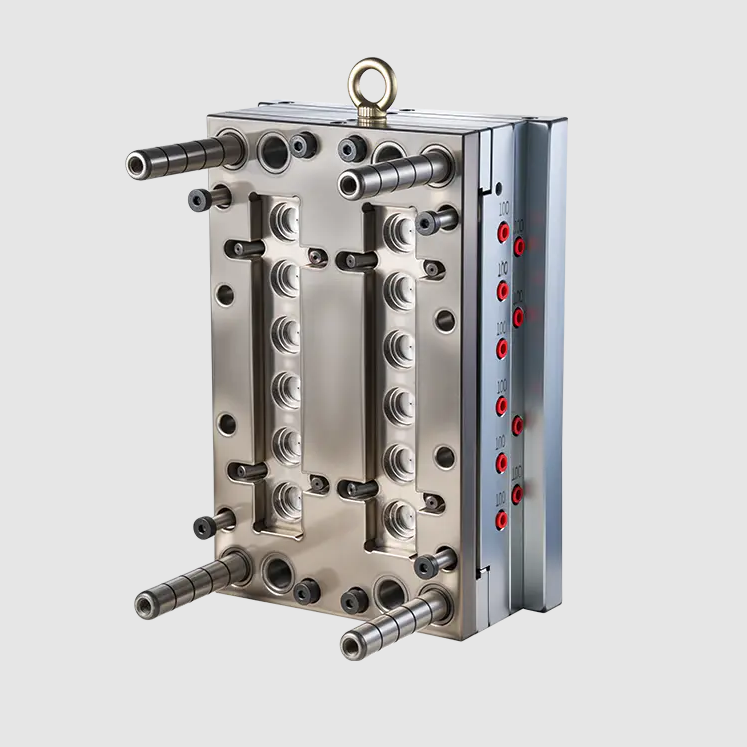
Creating plastic bottles begins with a Bottle Preform Mold that shapes molten resin into a precise intermediate form. The mold consists of two matching halves that close under high clamp force. Molten PET enters through a hot runner manifold and flows into multiple cavities arranged in a balanced layout. Each cavity contains the exact geometry of the preform body and the fully detailed neck finish. Once filled, the plastic cools and hardens, after which the mold opens and ejects the finished preforms.
Cooling channels form a vital network inside a Bottle Preform Mold. Water or other heat-transfer fluid circulates close to the cavity surfaces, removing heat quickly and evenly. Balanced cooling prevents differential shrinkage that could leave preforms with uneven wall thickness. Temperature sensors placed at strategic points allow operators to verify that every cavity reaches the same thermal state during the cycle. This consistency supports stable downstream stretch-blow performance.
The neck region of a Bottle Preform Mold receives particular care during machining. Thread profiles, sealing lands, and support ledges must match industry standards so that closures fit securely later. Polished surfaces in this area reduce friction during ejection and help maintain surface clarity. Gate design also plays a role; a properly sized gate allows rapid filling while leaving a small, clean remnant that does not interfere with the neck finish.
Steel quality and surface treatment affect how long a Bottle Preform Mold maintains its dimensions under continuous operation. Cavities experience repeated contact with hot, pressurized plastic, so hardness and corrosion resistance matter. Alignment features such as leader pins and interlocks keep the two halves in register, preventing flash or cavity mismatch. Venting slots allow air to escape as the plastic advances, ensuring complete fill without trapped gas pockets.

 English
 Arabic
 French
 Spanish
 Portuguese
 Deutsch
 Turkish
 Dutch
 Russian
 Romaian
 Portuguese (Brazil)
 Greek