


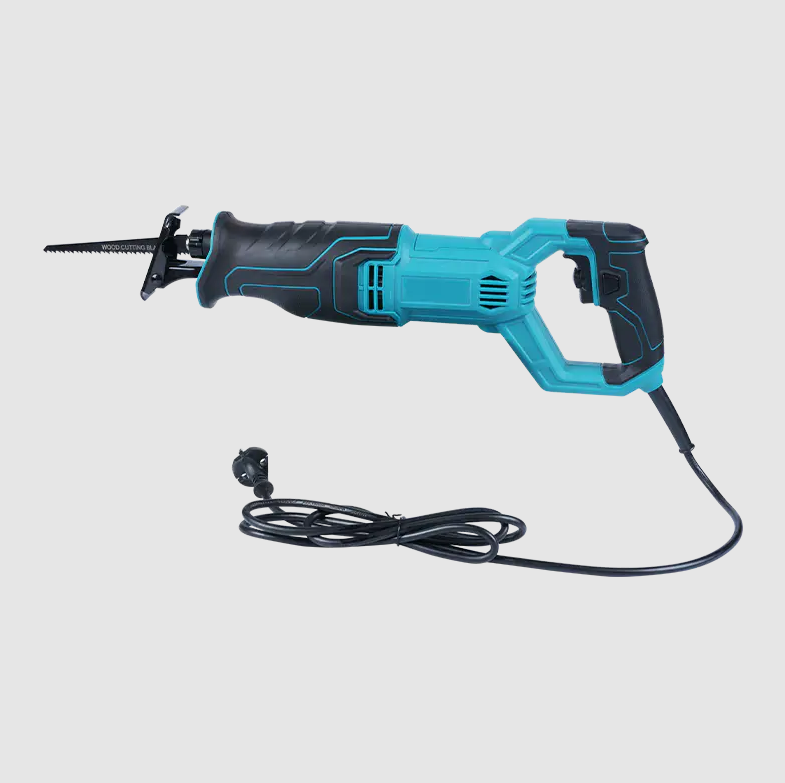
A lithium reciprocating saw combines a compact battery pack with a rapid back-and-forth blade motion that handles rough cutting tasks across wood, metal, and composite materials. The lithium cells supply steady current to the motor, allowing the tool to run without a trailing cord. This freedom of movement proves useful when working on elevated platforms, inside tight spaces, or across a job site where outlets sit far from the workpiece.
The reciprocating action itself drives a slender blade in a short linear stroke. Teeth engage the material on each forward push and clear debris on the return. Operators select blades according to the substance at hand: coarser teeth for framing lumber, finer patterns for metal pipe or sheet. A simple clamp or chuck holds the blade firmly, and a quick-release lever lets the user swap blades when the cut changes from timber to steel.
Weight distribution matters during extended sessions. The battery sits near the rear of the housing, balancing the forward mass of the motor and gear assembly. A padded grip and secondary handle give the user control over the tool’s angle and pressure. Pushing too hard slows the stroke and can stall the motor; a moderate feed rate keeps the blade moving freely and produces a cleaner kerf. The variable-speed trigger allows the operator to start slowly when lining up a cut and then increase speed once the blade has bitten into the surface.
In demolition settings the lithium reciprocating saw removes sections of wall studs, trims protruding nails, or severs old plumbing lines. The cordless design means the worker can climb a ladder or crawl into an attic without searching for an extension cord. On remodeling jobs the same tool cuts openings for windows or doorways, following chalk lines marked on drywall and framing. Outside, it trims tree limbs or cuts through fence boards when a chainsaw would prove too large for the space.
The lithium pack itself contributes to consistent performance throughout a work period. Voltage remains relatively stable until the cells near depletion, so the stroke rate does not drop sharply midway through a cut. A charge indicator on the pack or tool body gives a quick visual cue of remaining capacity. Users often keep a second pack charged and ready so work continues with only a brief pause for the swap.
Different materials reveal the saw’s range. Softwoods yield quickly under a coarse blade, while denser hardwoods require a slower pace and occasional pauses to clear chips. Thin-walled tubing and electrical conduit accept a metal-cutting blade that slices cleanly without crushing the walls. Even layered materials such as plywood or particle board respond well when the operator matches blade type to the outer veneer and core.
The lithium reciprocating saw therefore serves as a versatile companion for tasks that demand both mobility and aggressive cutting power. Its combination of battery energy and reciprocating motion lets the user tackle framing, remodeling, and outdoor work with a single tool that moves freely from one location to the next.

 English
 Arabic
 French
 Spanish
 Portuguese
 Turkish
 Dutch
 Italiano
 Russian
 Romaian
 Portuguese (Brazil)
 Greek