


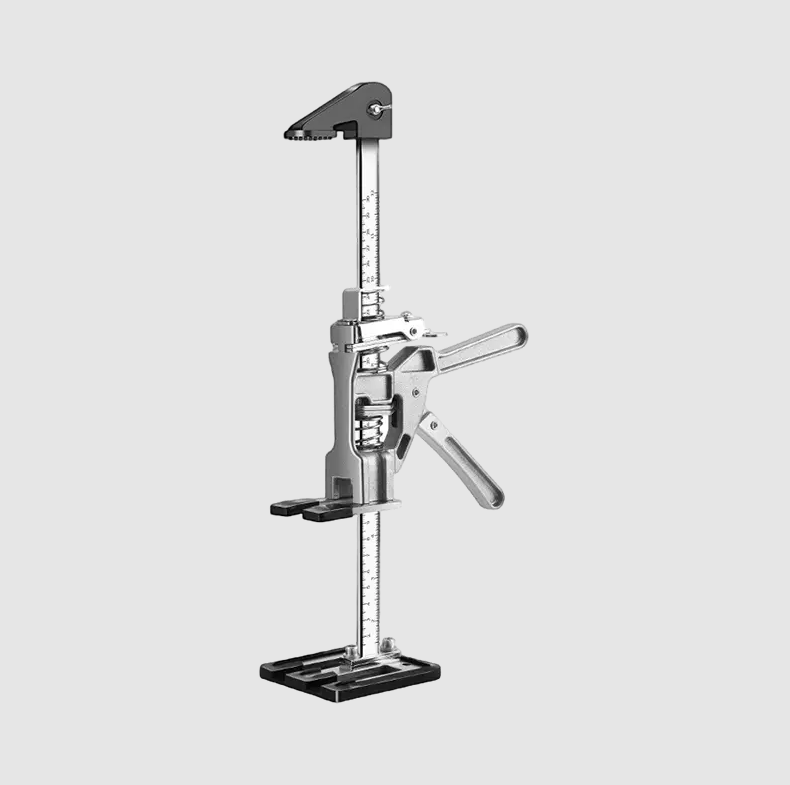
A hand lifting jack tool turns repeated pump strokes or lever motions into vertical movement that raises a vehicle frame, a machine base, or a heavy beam a few inches at a time. The operator places the base on solid ground, positions the saddle under a secure lift point, and begins working the handle. Each stroke compresses fluid or advances a ratchet, pushing the lifting ram upward in small, controlled increments. The process feels deliberate rather than sudden, giving time to check balance and clearance as the load leaves the ground.
Firm ground is essential because the entire force concentrates on the small footprint of the base. Soft soil or uneven concrete can let the jack tip or sink, shifting the load sideways. A short wooden pad or steel plate under the base spreads the pressure and keeps the tool upright. Once the base sits flat and the saddle contacts the lift point squarely, the hand lifting jack tool can begin its work without sideways stress on the ram.
The lever or pump handle multiplies the operator’s effort. A long handle reduces the force needed on each stroke while increasing the number of strokes required to reach full height. Some designs use a ratchet bar that clicks upward with each pull; others rely on a hydraulic piston that rises as fluid is forced into the cylinder. In both cases the motion stays under the operator’s direct control. Releasing the pressure valve or lowering the ratchet lets the load descend at a measured pace. A hand lifting jack tool therefore keeps both raising and lowering actions within the user’s immediate command.
Stability continues to demand attention as height increases. The higher the ram extends, the more important it becomes to keep the load centered over the base. Any tilt grows more noticeable, so the operator pauses after every few strokes to confirm that the saddle remains seated and the base has not shifted. When the desired height is reached, safety stands or blocks take the weight so the jack can be relieved. The hand lifting jack tool then returns to its lowered position, ready for the next placement.
Different loads call for different capacities, yet the basic sequence stays the same: position, pump or ratchet, check, and secure. A compact unit handles lighter tasks such as raising one corner of a small trailer. A larger model manages heavier frames or equipment. In each case the operator’s rhythm of short, steady strokes determines how smoothly the lift progresses. The hand lifting jack tool converts that human effort into reliable vertical travel, giving a practical way to create working space under objects that cannot be lifted by hand alone.

 English
 Arabic
 French
 Spanish
 Portuguese
 Deutsch
 Turkish
 Dutch
 Italiano
 Russian
 Romaian
 Greek