


Introduction
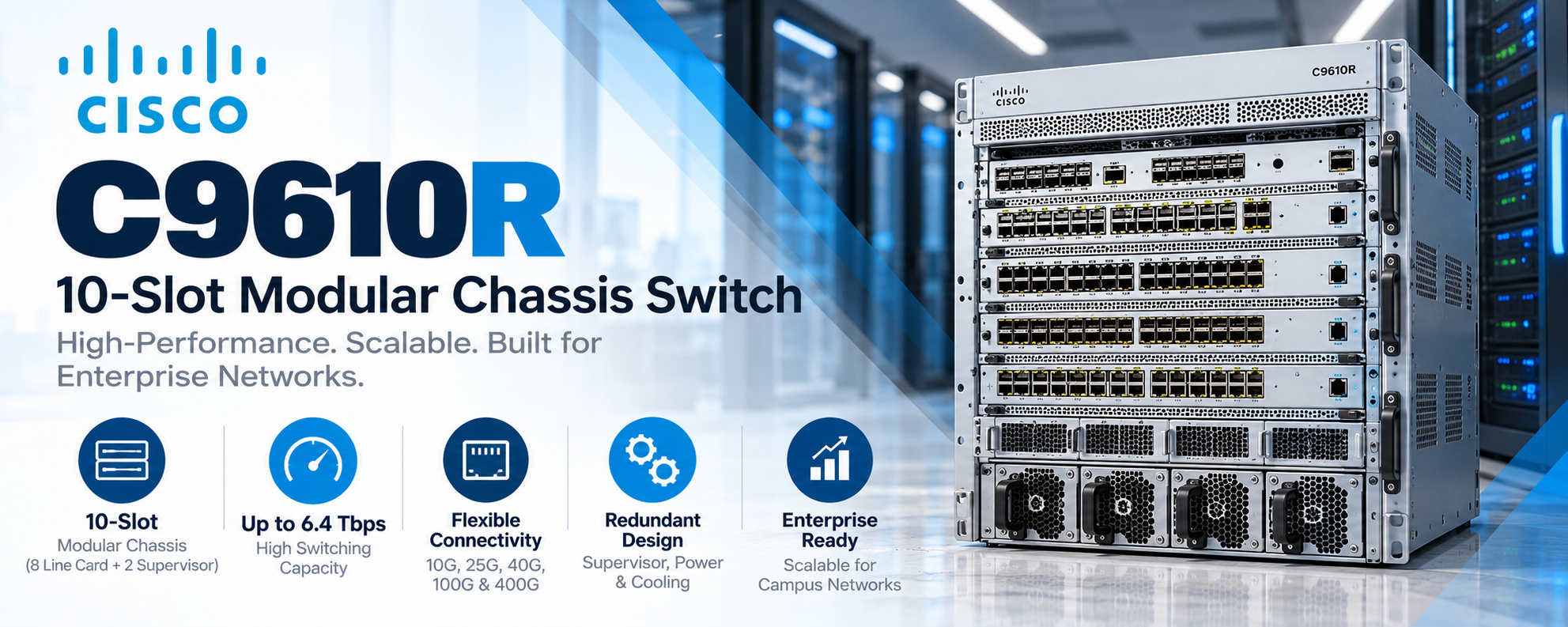
Enterprise networks require high-performance switching infrastructure to support growing traffic, cloud applications, data-intensive workloads and thousands of connected devices. The Cisco C9610R 10-Slot Modular Chassis Switch is designed for large enterprise campus networks that need scalable connectivity, high availability and flexible hardware configurations.
Unlike fixed-port switches, the C9610R uses a modular architecture that allows organizations to select compatible supervisor engines, line cards and power supplies according to their networking requirements.
This guide explains the Cisco C9610R's key features, technical specifications, performance capabilities, redundancy options and common enterprise applications.
What Is the Cisco C9610R Switch?
The Cisco C9610R is a 10-slot modular chassis switch from the Cisco C9610 Series, designed primarily for enterprise campus core and distribution networks.
It provides the physical infrastructure for installing supervisor engines, Ethernet line cards, cooling assemblies and power supplies.
The chassis contains eight dedicated line card slots and two supervisor engine slots, allowing businesses to build a switching system around their network capacity and connectivity requirements.
Unlike a conventional fixed-port network switch, the C9610R chassis does not include a standard set of built-in Ethernet interfaces. Its available ports depend on the compatible line cards installed.
This modular approach makes the platform suitable for large organizations planning long-term network expansion.
Key Features of the Cisco C9610R Chassis
10-Slot Modular Architecture
One of the most important features of the C9610R is its modular design.
The chassis provides eight line card slots and two dedicated supervisor engine slots.
Slots 5 and 6 accommodate the supervisor engines, while the remaining eight slots support compatible Ethernet line cards.
This architecture gives network administrators flexibility when selecting port speeds, connection types and interface density.
Instead of replacing an entire fixed-port switch when connectivity requirements change, organizations can evaluate supported line card upgrades.
Modular expansion is particularly useful in enterprise networks where capacity requirements may increase over time.
High-Density Ethernet Connectivity
The C9610R supports several Ethernet interface configurations depending on the installed line cards.
With appropriate supported hardware, the platform can accommodate up to 448 native 10G, 25G or 50G ports, up to 256 native 40G or 100G ports, or up to 16 native 400G ports.
These figures describe alternative maximum hardware configurations rather than a single configuration containing every listed interface.
High-density connectivity allows enterprises to consolidate network connections into a modular platform.
The actual port configuration depends on the supervisor engine, line cards, optics and supported software.
High-Performance Supervisor Engines
The Cisco C9610R supports two supervisor engine options: C9610-SUP-3 and C9610-SUP-3XL.
Supervisor engines provide the processing and control functions required to operate the switching system.
They manage routing and switching operations, network protocols, system control and supported management capabilities.
The Supervisor 3 models use Cisco Silicon One technology to support high-performance enterprise networking.
The appropriate supervisor depends on the required forwarding scale, memory, routing requirements and installed line cards.
Redundant Supervisor Architecture
Network downtime can disrupt business operations, applications and communication services.
The C9610R supports two supervisor engines, allowing organizations to configure supervisor redundancy.
With compatible hardware and software, technologies such as Stateful Switchover help maintain supported network operations when an active supervisor fails.
This capability is particularly valuable in campus core networks where many buildings or departments depend on the same switching infrastructure.
However, achieving high availability requires appropriate configuration and does not eliminate every possible cause of network interruption.
Cisco C9610R Switching Performance
High Bandwidth Scalability
The C9610R is built for enterprise environments requiring substantial network capacity.
With supported Supervisor 3 hardware, Cisco specifies maximum bandwidth scalability of up to 6.4 Tbps per line card slot, expressed as 3.2 Tbps full-duplex in the published data sheet.
This capacity supports high-bandwidth switching designs using compatible line cards.
Actual forwarding performance depends on the complete hardware configuration, software support and traffic characteristics.
100G and 400G Network Connectivity
Modern enterprise networks increasingly require faster connections between aggregation layers, core switches and critical infrastructure.
The C9610R supports compatible line cards offering high-speed interfaces, including 100 Gigabit and 400 Gigabit Ethernet.
These connections are useful when consolidating traffic from multiple distribution switches or supporting high-capacity network backbones.
However, 100G and 400G ports are not built into the C9610R chassis.
Businesses must select the appropriate line cards, transceivers and supporting hardware to enable the required connectivity.
Network Redundancy and High Availability
Redundant Power Supplies
The Cisco C9610R includes eight power supply bays and supports compatible AC and DC power supplies.
The platform supports different power redundancy arrangements, including N+1 and N+N configurations.
These options help businesses reduce the risk of power-related service interruptions.
The correct number and type of power supplies depend on the installed hardware, electrical requirements and desired redundancy level.
For example, a high-density deployment with multiple line cards may require a different power configuration from a partially populated chassis.
Redundant Cooling System
Large modular switches generate heat during continuous operation.
The C9610R uses four fan tray assemblies and a front-to-back airflow design.
Its cooling system helps maintain suitable operating temperatures for installed modules.
Organizations should ensure that the rack layout, cooling infrastructure and available service clearance meet the manufacturer's requirements.
Maintaining proper airflow is essential for reliable operation, particularly in heavily populated network racks.
Software Availability Features
The configured C9610R system runs Cisco IOS XE and supports enterprise availability features with the appropriate hardware and software.
Supported capabilities include Stateful Switchover, Nonstop Forwarding and In-Service Software Upgrade functionality.
These technologies are designed to reduce certain interruptions during supervisor transitions and supported maintenance activities.
Their availability and operational behavior depend on software releases, configurations and platform compatibility.
Cisco IOS XE Network Management
Centralized Network Administration
Cisco IOS XE provides the operating environment for a configured C9610R switching system.
It supports network management, monitoring and configuration through established administrative interfaces.
IT teams can use supported automation and telemetry capabilities to manage network settings and observe system performance.
This is particularly useful for organizations operating large campus networks with multiple switching platforms.
Network Automation and Programmability
Large networks often require repetitive configuration changes across many devices.
The Cisco IOS XE platform supports model-driven management and programmability features that can help automate suitable network tasks.
Automation can reduce manual configuration effort and improve consistency when properly designed and tested.
However, businesses should validate automation workflows before applying changes to production infrastructure.
Enterprise Network Security
The C9610R can form part of an enterprise security architecture using supported access controls, traffic segmentation and network policy capabilities.
Security functionality depends on the installed supervisor, software version and applicable licensing.
Organizations should consider firmware maintenance, administrative access protection and security monitoring as part of their overall deployment plan.
Common Applications of the Cisco C9610R
Enterprise Campus Core Networks
The C9610R is particularly suitable for large campus core networks.
These environments may connect multiple office buildings, departments, distribution switches and shared infrastructure.
Its modular architecture allows organizations to select high-capacity interfaces while maintaining flexibility for network expansion.
Large Corporate Networks
Large businesses often require switching platforms capable of handling traffic from many connected departments and applications.
A properly configured C9610R can provide the high-speed connectivity needed to aggregate traffic from multiple network segments.
Redundant supervisors and power configurations can further support availability requirements.
Educational and Healthcare Campuses
Universities, hospitals and other multi-building organizations depend on reliable communication between distributed network locations.
The C9610R can support backbone connectivity where high interface density and network resilience are important.
System design should account for bandwidth, fault tolerance and the specific operational requirements of the institution.
Cisco C9610R Installation Requirements
The Cisco C9610R occupies 18 rack units and measures approximately 31.47 inches high, 17.4 inches wide and 26.1 inches deep.
Its size makes it suitable for dedicated enterprise equipment racks rather than compact wall-mounted network cabinets.
Before installation, IT teams should confirm rack capacity, electrical availability, cooling arrangements and physical service access.
The complete operating system requires compatible supervisor engines, line cards, four fan trays and an appropriately sized power supply configuration.
Buyers should distinguish between purchasing the chassis alone and purchasing a fully configured system.
Is the Cisco C9610R Worth Buying?
The C9610R is a strong option for large enterprises that need scalable, high-density campus switching infrastructure.
Its modular architecture, high-speed line card options, supervisor redundancy and flexible power configurations support demanding networking requirements.
However, it may be unnecessarily complex for smaller businesses that need only a limited number of fixed Ethernet ports.
Organizations should evaluate expected traffic growth, required port speeds, hardware compatibility, software subscriptions and long-term operating costs.
The C9610R is best suited to enterprise core and distribution environments where scalability and availability justify a modular switching platform.
Frequently Asked Questions
What is the Cisco C9610R?
The Cisco C9610R is a 10-slot modular chassis switch designed for enterprise campus core and distribution networking. It supports separate supervisor engines, Ethernet line cards, redundant power options and high-speed interfaces.
How many slots does the Cisco C9610R have?
The C9610R has 10 slots, including eight dedicated line card slots and two supervisor engine slots. The supervisor slots are numbered 5 and 6.
Does the Cisco C9610R support 400G Ethernet?
Yes. With supported line cards and appropriate hardware, the C9610R can support up to 16 native 400 Gigabit Ethernet ports. These ports are configuration-dependent and are not included with the bare chassis.
What supervisor engines are compatible with C9610R?
The C9610R supports the Cisco C9610-SUP-3 and C9610-SUP-3XL supervisor engines. The appropriate option depends on the required network scale and deployment configuration.
Does the Cisco C9610R support redundant power supplies?
Yes. The chassis provides eight power supply bays and supports configurable redundancy arrangements, including N+1 and N+N modes, with compatible power supplies.
Is the Cisco C9610R a Layer 3 switch?
A properly configured C9610R system supports enterprise Layer 3 routing capabilities through compatible supervisor hardware and Cisco IOS XE software. The bare chassis does not provide routing functionality by itself.
Does the Cisco C9610R support PoE?
No. The C9610R is designed primarily for high-performance enterprise core and distribution connectivity rather than delivering Power over Ethernet to endpoint devices.
What operating system does the Cisco C9610R use?
The C9610R uses Cisco IOS XE when configured with compatible supervisor engines and the required software.
How much rack space does the Cisco C9610R require?
The C9610R requires 18 rack units of vertical space. Additional planning is necessary for ventilation, cable routing, power distribution and maintenance access.
Does the Cisco C9610R include line cards?
The C9610R chassis model does not establish an included line card configuration. Buyers should verify whether the selected offering includes supervisor engines, line cards, power supplies and fan trays.
Conclusion
The Cisco C9610R 10-Slot Modular Chassis Switch provides a scalable foundation for high-performance enterprise campus networking.
With eight line card slots, two supervisor slots, high-speed Ethernet options and redundant hardware capabilities, it supports organizations that need reliable core and distribution infrastructure.
Before purchasing, businesses should confirm the complete hardware configuration, compatible modules, software requirements and future expansion plans to ensure the system meets their networking needs.
Technical verification: Specifications are based on Cisco's official C9610 Series data sheet and architecture documentation, including the distinction between the chassis alone and a fully configured switch.

 English
 French
 Spanish
 Portuguese
 Deutsch
 Turkish
 Dutch
 Italiano
 Russian
 Romaian
 Portuguese (Brazil)
 Greek