


Introduction
Construction sites contain valuable equipment, expensive building materials and machinery that can attract thieves, vandals and trespassers. Without proper security, a single incident can result in financial losses, damaged equipment and unexpected project delays.
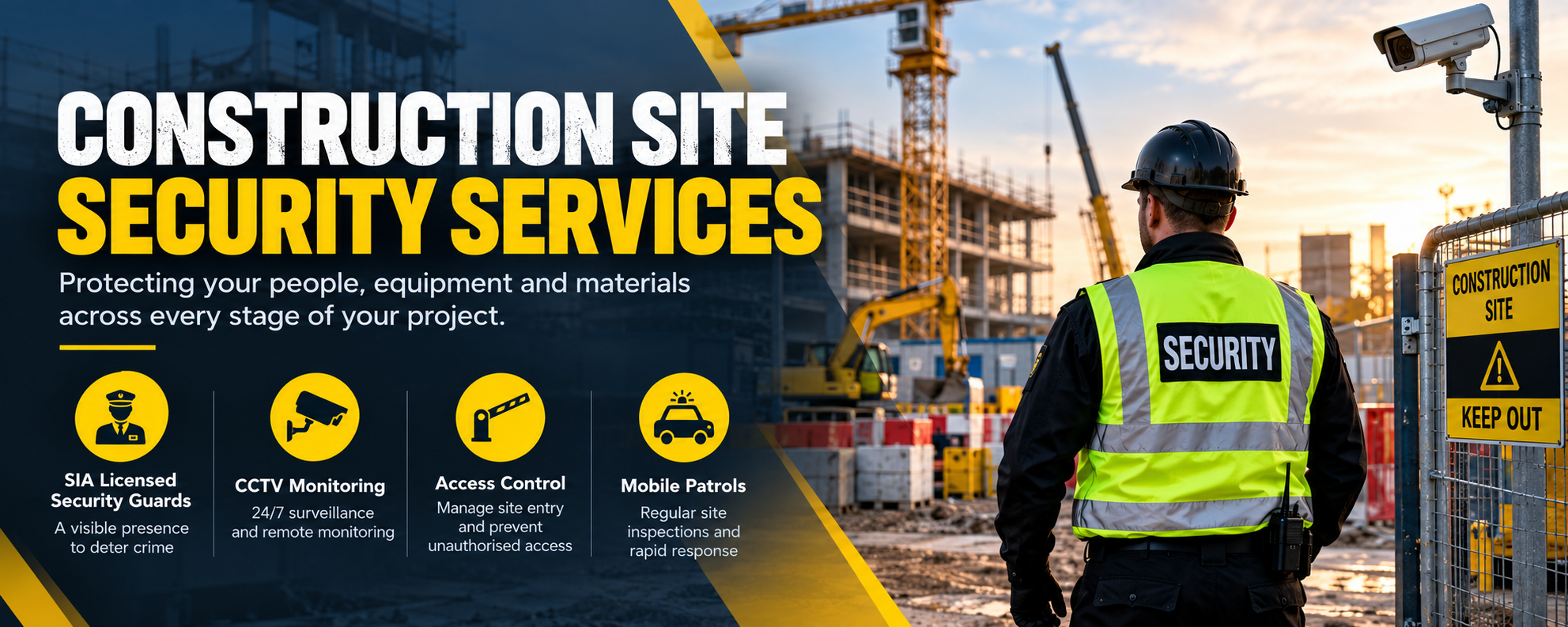
Construction site security services protect building sites through trained security guards, CCTV surveillance, access control and regular patrols. These measures help prevent unauthorised access, protect workers and safeguard valuable assets throughout a construction project.
This guide explains the importance of construction security, the different services available, UK legal responsibilities, costs and how to choose the right security provider.
What Is Construction Site Security?
Construction site security involves using professional security personnel, surveillance technology and physical protection measures to safeguard building projects from criminal activity and unauthorised access.
Security arrangements may include SIA-licensed guards, mobile patrols, monitored CCTV cameras, perimeter fencing, access control and intruder detection systems.
Unlike permanent commercial properties, construction sites change throughout a project. New entrances, temporary structures, equipment movements and changing work areas can create additional security risks.
Therefore, construction security plans should adapt to the different stages of development, from initial groundwork to final completion.
Why Is Construction Site Security Important?
Preventing Equipment and Material Theft
Construction sites often store expensive machinery, generators, power tools, copper cables and building materials.
These assets can become attractive targets for theft, particularly when sites are unattended overnight or during weekends.
Professional security guards, controlled entrances and surveillance cameras can discourage criminal activity and help detect suspicious behaviour.
Preventing theft also reduces the risk of replacing equipment and experiencing unexpected construction delays.
Protecting Against Vandalism
Vandalism can cause significant disruption to building projects. Criminal damage to machinery, temporary structures or newly completed work may require expensive repairs.
Visible security personnel and monitored surveillance systems help discourage unwanted activity.
Regular patrols can also identify damage or suspicious behaviour before further problems develop.
Reducing Unauthorised Access
Construction sites contain hazards such as excavations, scaffolding, heavy machinery and exposed electrical equipment.
Unauthorised visitors, including children and other members of the public, may be exposed to serious risks if they enter an unsecured site.
Security personnel can monitor entrances, check visitor authorisation and report weaknesses in perimeter protection.
These measures support the wider responsibility to prevent unauthorised site access.
Supporting Project Continuity
Security incidents can interrupt construction schedules, affect contractor availability and increase operating costs.
A suitable security strategy helps reduce avoidable disruptions by protecting equipment, materials and site infrastructure.
This allows project managers to focus on construction activities while maintaining appropriate site protection.
Types of Construction Site Security Services
Manned Construction Site Security Guards
Manned guarding provides a visible security presence at construction sites, helping deter theft, vandalism and trespassing.
SIA-licensed security officers can monitor entrances, conduct patrols, check visitor authorisation and respond to suspicious activity.
Guards may be positioned at site gates, temporary offices, storage compounds or other areas requiring additional supervision.
Their duties should be defined in a site-specific security plan that reflects the project's layout and operational risks.
Mobile Security Patrols
Mobile security patrols provide scheduled or risk-based inspections of construction sites.
During visits, officers may check perimeter fencing, gates, doors, storage areas and signs of unauthorised entry.
Mobile patrols can be suitable for smaller sites where permanent guarding is not necessary.
However, because patrol officers are not continuously present, they cannot provide the same immediate on-site response as a permanently stationed guard.
Construction Site CCTV Monitoring
CCTV surveillance allows businesses to monitor entrances, equipment storage areas and other important locations.
Modern construction site CCTV systems may include motion detection, night vision, remote monitoring and video recording.
Temporary camera towers can be particularly useful where permanent camera infrastructure is unavailable.
When connected to a suitable monitoring service, CCTV can help operators assess suspicious activity and arrange an appropriate response.
Camera placement, lighting, power availability and network connectivity should be considered before installation.
Access Control and Gatehouse Security
Construction sites frequently receive deliveries, contractors, subcontractors and visitors.
Access control arrangements help prevent unauthorised individuals from entering restricted areas.
Security officers may verify visitor identification, manage access permissions and maintain entry records.
Electronic access systems can provide additional control where suitable equipment and infrastructure are available.
Effective gatehouse security can also help maintain orderly vehicle movements and reduce congestion near site entrances.
Alarm Response and Key Holding
Intruder alarms can provide warnings when suspicious activity is detected outside working hours.
Alarm response services arrange for authorised personnel to investigate activations according to agreed procedures.
Professional key holding services can support secure access to gates, cabins and protected buildings.
These services are particularly useful when project managers cannot attend the site outside normal operating hours.
What Do Construction Security Guards Do?
Monitoring Site Entrances
Construction security officers monitor designated entry points and help ensure only authorised personnel access the site.
This may involve checking identification, verifying delivery details and following visitor registration procedures.
Conducting Regular Security Patrols
Guards inspect relevant areas of the site to identify security concerns.
Patrol routes may include equipment compounds, temporary offices, storage areas, perimeter boundaries and access gates.
Any suspicious activity or security weakness should be recorded and reported to the appropriate site representative.
Protecting Construction Equipment
Heavy machinery and portable equipment require appropriate security because theft can create substantial replacement costs.
Security personnel help protect these assets by monitoring storage locations, checking site access and reporting unusual activity.
Physical security measures such as secure compounds, lighting and equipment immobilisation can provide additional protection.
Reporting Incidents and Emergencies
Security officers follow agreed procedures when incidents occur.
Their responsibilities may include contacting emergency services, notifying site management, preserving relevant information and preparing incident reports.
Clear communication helps construction managers respond to problems without unnecessary delays.
UK Construction Site Security Regulations
The Construction (Design and Management) Regulations 2015, commonly known as CDM 2015, establish important health and safety responsibilities for construction projects.
Principal contractors must take reasonable steps to prevent unauthorised access to construction sites.
Regulation 18 also requires construction site boundaries to be suitably identified, fenced or both, where this is necessary to protect people from risks.
The Health and Safety Executive provides guidance on suitable site boundaries, public protection and managing access.
Professional guarding can support these responsibilities, but employing security officers does not automatically demonstrate full legal compliance.
Businesses using contracted security guards should also check that personnel hold the appropriate Security Industry Authority licence for their duties.
How Much Does Construction Site Security Cost in the UK?
The cost of construction site security depends on site size, location, operating hours and the level of protection required.
A small residential development requiring occasional mobile patrols may have lower security costs than a large commercial project needing continuous guarding.
Sites operating around the clock may require multiple guard shifts, increasing overall staffing costs.
CCTV systems introduce different expenses, including equipment hire, installation, monitoring, connectivity and maintenance.
Additional requirements such as remote locations, multiple entrances or specialist equipment protection can also affect pricing.
Businesses should request a tailored quotation based on their security assessment rather than relying on a fixed national price.
Construction Security Guards vs CCTV: Which Is Better?
Both security guards and CCTV systems provide valuable protection, but they serve different purposes.
Security guards provide a physical presence and can assess situations, control entrances and respond according to their instructions.
CCTV systems provide visual surveillance, allowing monitoring teams to observe designated areas and review recorded incidents.
Cameras may be especially useful for monitoring isolated sections of a site, while guards can manage access and investigate suspicious activity.
For larger or higher-risk construction projects, combining professional guarding with monitored CCTV often provides more comprehensive protection than relying on either measure alone.
How to Choose the Right Construction Security Company
Selecting a suitable construction security provider requires more than comparing hourly guarding rates.
Businesses should consider the provider's experience with active construction environments, SIA licensing arrangements, supervision procedures and incident reporting standards.
A reliable provider should assess site-specific risks before recommending guarding levels or security technology.
Communication with project managers is also important because construction activities, access points and site hazards can change frequently.
Intraguard provides construction site security services across the UK, combining SIA-licensed security officers, access control, perimeter monitoring and site patrols.
Its services are designed around the layout, operating requirements and risk profile of individual construction projects.
Frequently Asked Questions
What is construction site security?
Construction site security involves protecting building sites, equipment, materials and personnel from theft, vandalism and unauthorised access through professional guarding, surveillance and access control.
Why do construction sites need security guards?
Construction sites need appropriate security measures because valuable equipment, building materials and exposed work areas can attract theft, vandalism and trespassing. Guards help deter incidents and manage access.
Are construction security guards required to have an SIA licence?
Contracted security personnel undertaking licensable guarding activities generally require the appropriate SIA licence. The exact requirements depend on their duties and employment arrangements.
Can construction site security be provided 24 hours a day?
Yes. Construction security providers can arrange 24-hour guarding or monitoring services where required. The appropriate coverage depends on site risks, project requirements and staffing arrangements.
How much does a construction security guard cost in the UK?
Guarding costs vary depending on location, shift patterns, contract duration, staffing requirements and site risks. A tailored quotation provides a more accurate estimate than a general hourly rate.
Is CCTV enough to protect a construction site?
CCTV can help detect suspicious activity and provide recorded evidence, but it may not be sufficient on its own. Higher-risk sites may also require guarding, physical barriers, alarms and effective response arrangements.
What is the difference between manned guarding and mobile patrols?
Manned guarding provides an officer at the site during contracted hours. Mobile patrols involve officers visiting the site at intervals to inspect designated areas and report security concerns.
Who is responsible for construction site security?
The principal contractor has important duties to manage construction site access under CDM 2015. Clients, site owners and other dutyholders may also have relevant responsibilities. Security providers can carry out agreed tasks but do not remove those legal duties.
Can security services prevent construction project delays?
Security measures can reduce the likelihood of delays caused by theft, vandalism and unauthorised access. However, no security arrangement can guarantee that incidents will never occur.
When should construction site security begin?
Security planning should begin before construction activities start. Early arrangements help protect equipment, establish access procedures and address risks from the first stage of the project.
Conclusion
Construction site security services help protect building projects from theft, vandalism, trespassing and unnecessary disruption. A well-designed security strategy combines trained personnel, surveillance technology, access control and physical protection measures.
Because construction sites change throughout their development, security arrangements should be reviewed regularly to reflect new risks and operating conditions.
Businesses seeking reliable site protection should work with an experienced security provider to develop suitable arrangements that safeguard people, equipment and project progress.
Research basis: Service details were checked against Intraguard's construction security offering, and legal responsibilities against Health and Safety Executive guidance.

 Arabic
 French
 Spanish
 Portuguese
 Deutsch
 Turkish
 Dutch
 Italiano
 Russian
 Romaian
 Portuguese (Brazil)
 Greek