


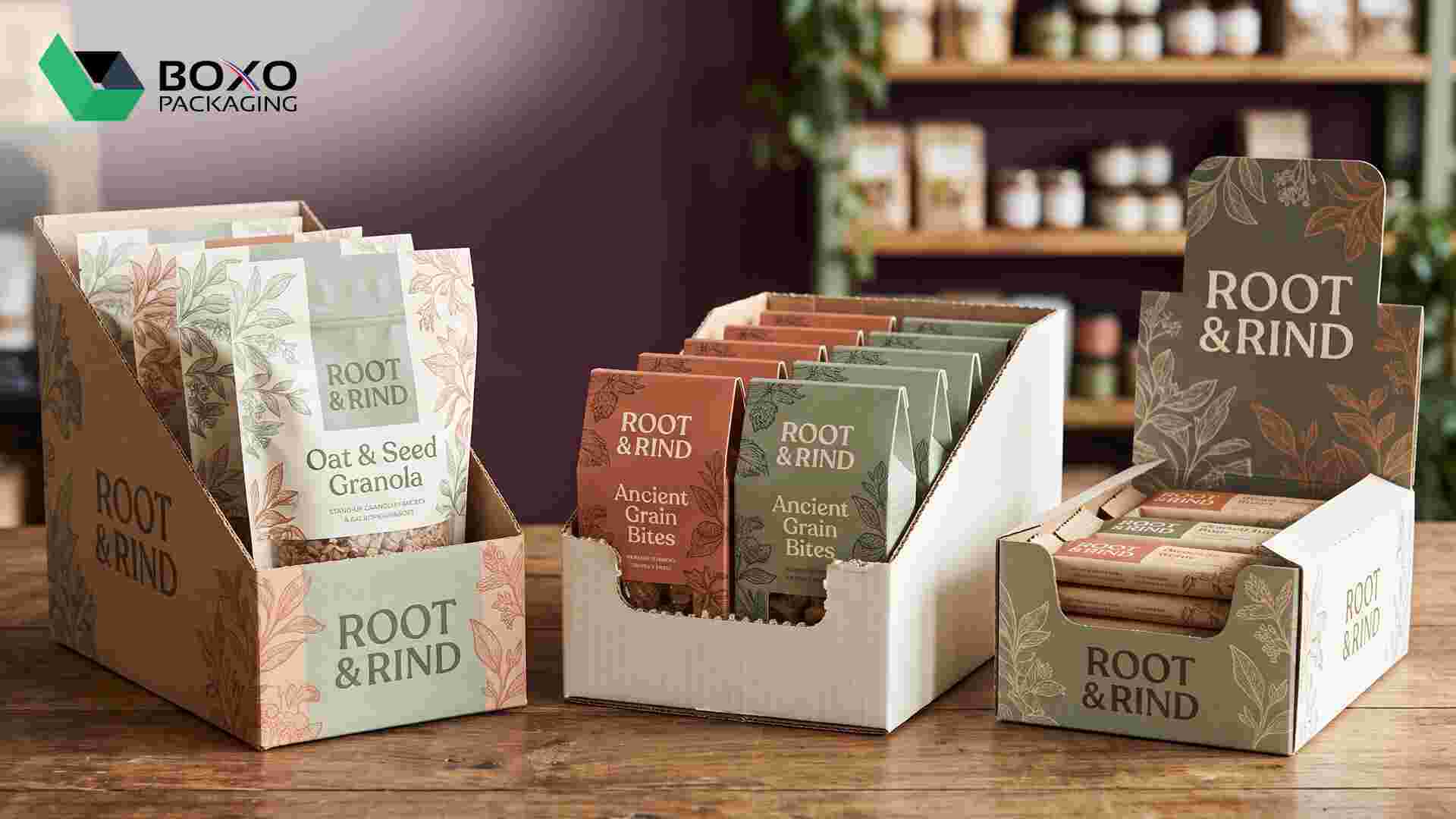
Shoppers often give a product only a second or two before moving on. Well planned product display boxes help your item win that moment, keep stock tidy and protect goods on the way from factory to shelf. This guide covers the main styles, materials and cost factors so you can brief a supplier clearly.
What a Product Display Box Does
A product display box is a carton built to hold several units and present them without unpacking each one. It usually opens with a tear strip, a hinged lid or a cut away front panel, so staff can place it straight onto a counter or shelf.
The aim is to save time and keep products visible. A good box also leaves space for a logo, price panel or promotional message at eye level.
Styles and Where They Fit
The best style depends on where the product will sit and how quickly it sells. Four options cover most requests:
- Counter boxes: small units for impulse items such as sweets, cosmetics and accessories.
- Shelf ready trays: corrugated trays with a perforated lid that tears away for fast restocking.
- Floor standing displays: tiered units for seasonal promotions and new launches.
- Pallet displays: large corrugated shells that hold a full pallet of stock for supermarkets.
Smaller retailers often start with counter boxes, as they cost less and need no floor space.
Materials and Board Strength
Corrugated board is the usual choice for anything that must stand upright and carry weight. Single wall E or B flute suits lighter counter units, while double wall board is better for floor displays holding heavier goods.
Folding carton board of around 300 to 400 GSM works well for small, light units with sharp printing. For anything touching food, ask your supplier for board suitable for direct contact and confirm it meets UK food contact rules.
At Boxo Packaging, we usually ask for product weight, shelf height and the number of units per display before suggesting a board grade. These details decide wall thickness far more than appearance does.
Printing and Finishing Choices
Digital printing suits short runs and frequent design changes. Offset printing gives richer colour and a lower unit price on larger orders, while flexographic printing is common directly on corrugated board.
Matt lamination, spot UV and foil add a premium look, though each raises the cost. A bold one or two colour design on kraft board can still stand out and stay affordable.
Cost Factors and Sustainability
Order quantity has the biggest effect on price, since setup and tooling are spread across more units. Board grade, size, print colours and finishing then add to the total, and a new cutting die is a one off charge.
Look for FSC certified board, water based inks and single material designs that recycle more easily. Avoid claiming a box is “fully green”, as every material has some footprint. Plastic windows and heavy lamination can complicate recycling.
Ordering Tips Before You Commit
Request a physical sample and fill it with real stock. Check that it stays upright when loaded, that the front panel does not sag and that staff can assemble it quickly.
Allow extra lead time, since production and freight can take several weeks. A reliable supplier will question your specification rather than simply accept it. That is how we work at Boxo Packaging, because fixing a problem early costs far less than a reprint, especially with product display boxes.
Eyelashes Packaging That Keeps Lash Sets Neat and Curled
A lash set can leave the studio perfectly curved and reach the customer flattened, tangled or stuck to its tray. Curl memory is delicate, and a poorly fitted carton can undo it in a single journey. Planning Eyelashes Packaging around the tray, the lid and the postal route helps each set keep its shape. These checks cover what to measure, test and ask before you order.
Why Curl Is Easier to Lose Than to Create
Lashes are fine, light and springy, so even gentle pressure can bend them. A lid that sits too close, or a tray with a shallow well, will press the tips flat over time.
Take one finished set and measure its length, width and the height of the curve. Then add a little clearance above the tips. Write the internal dimensions in the order length, width, height so nobody reads them back to front when the order is placed.
Choosing a Tray That Holds Without Gripping
The tray has two jobs: keep the lashes still and let customers lift them out without a struggle. A tray that grips too firmly can pull the band out of shape.
Place a real set in a sample tray and close the lid. Shake the box gently and listen for movement, then open it and check that the curl and the band look unchanged. Try lifting the lashes out with tweezers and with fingertips, because customers do both.
Single Pairs, Multipacks and Magnetic Sets
A single pair needs a slim carton, but a multipack needs room for several trays or layers. Magnetic sets add a small liner and sometimes an applicator, which changes the depth.
List everything that goes inside, from lashes and liner to a mirror card or glue tube. Lay the items out as you would pack them and measure the whole block. Any item that is added later, such as a free gift, should be included now so the box does not bulge.
Making Style Names and Lengths Easy to Read
Shoppers choose lashes by name, length and curl, and small errors lead to returns. Keep each style name clear and give the length its own line.
Ask for a printed sample and read it at arm’s length in daylight and under mirror lighting. Pale text on a soft colour can fade, and tiny type on a glossy surface can blur. Rub the print with a dry cloth, then a barely damp one, to see whether it marks.
Labels, Adhesives and Rules to Check
Lash products can carry ingredient lists, adhesive notes and usage warnings, so leave a clear, flat panel for them. Rules on labelling and product claims differ by region, so check the current requirements for your market. This is general information, not legal advice.
Four Details to Confirm Before You Request a Quote
Send these together and your quote will be quicker and easier to compare:
- The internal length, width and height, measured around the set with its tray
- The tray or insert style needed to protect the curl
- The print colours, finishes and the space reserved for style names and warnings
- Your first order quantity and the reorder volumes you expect
Letting Real Lash Sets Prove the Fit
A flat drawing cannot show how a curl behaves under a closed lid. At Boxo Packaging, the process starts with you sending over your lashes, so the fit is judged against the real product. You then request samples, test them with your own trays, handling and posting routine, and review the fit, print and structure together. Production begins only once you are satisfied, which makes it easier to settle on Eyelashes Packaging that suits every style in your range.
Good lash cartons come from honest measuring, a tray that holds without squeezing and print that stays readable in real light. Boxo Packaging supports that careful, sample-first approach, so every set reaches your customer with its curl intact.

 Arabic
 French
 Spanish
 Portuguese
 Deutsch
 Turkish
 Dutch
 Italiano
 Russian
 Romaian
 Portuguese (Brazil)
 Greek