


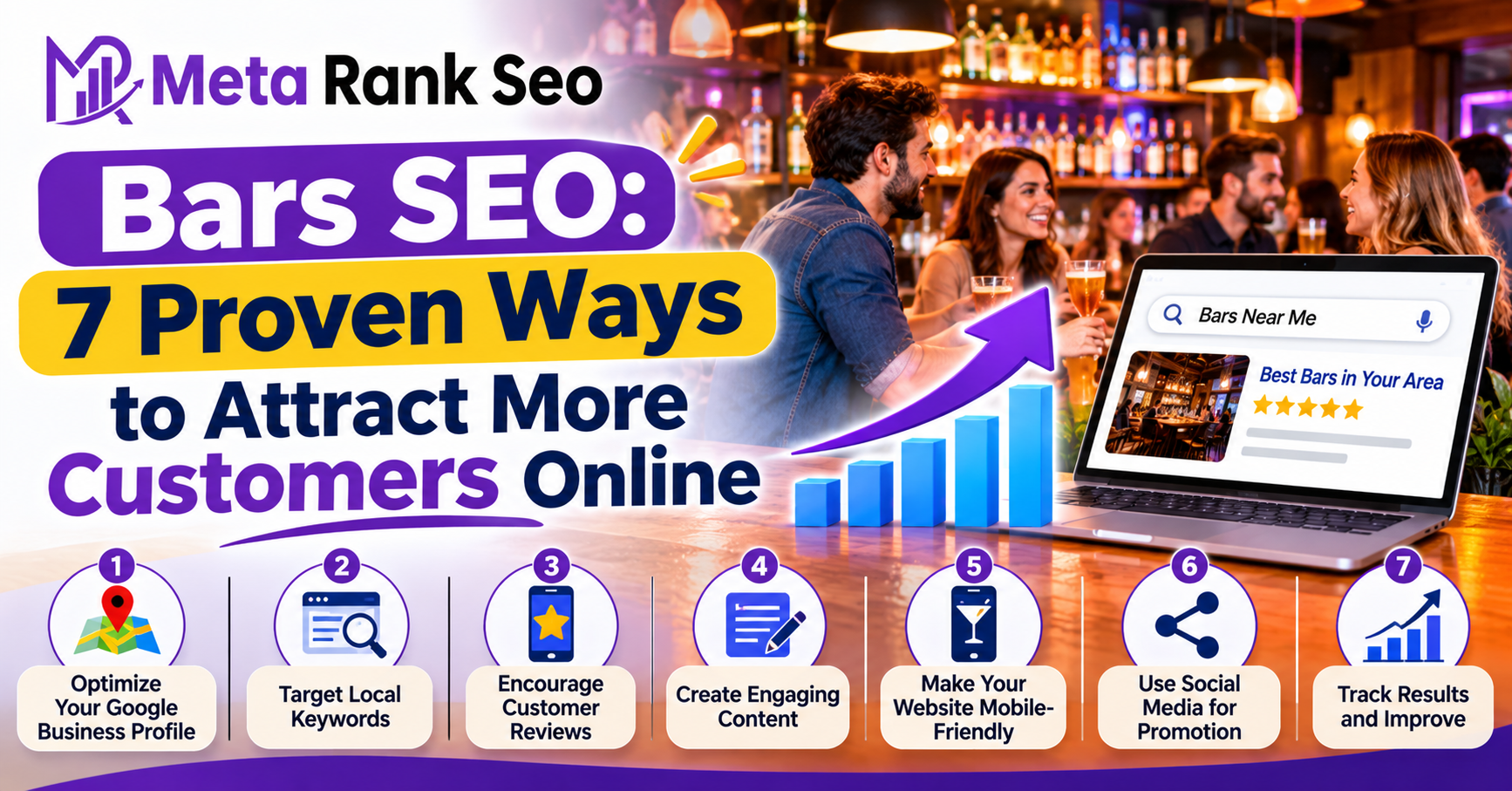
It is Friday afternoon, and a group of friends is deciding where to go tonight. Nobody is calling around. Someone types “bars near me,” “happy hour tonight” or “best cocktail bar downtown” into their phone, glances at the top few results, and picks one. If your bar is not visible, or its hours, menu and photos look out of date, you never get the chance to impress them.
Search engine optimization (SEO) makes sure your bar appears at the moments when people decide where to spend their evening. Below are seven proven ways to do it, organized around how customers actually search. If you would like a specialist team to handle the work, our Bars SEO Services are designed for exactly this kind of business.
How Customers Search for a Bar
Search behavior for bars falls into three stages, and a good SEO plan covers all of them.
Awareness (top of funnel). People are looking for ideas. They search “fun things to do on Friday night,” “best date night spots” or “how to make an old fashioned.” They have not picked a venue yet.
Consideration (middle of funnel). People are comparing venues. They search “sports bar near me,” “rooftop bar downtown” or “bars with live music.” Your profile, photos, menu and reviews decide whether you make the shortlist.
Decision (bottom of funnel). People are ready to go. They search “bar open now,” “happy hour near me” or “book a table at [bar name].” Accurate hours and an easy way to call, reserve or navigate win the visit.
The seven strategies below map onto these stages.
1. Complete and Maintain Your Google Business Profile
For nearly every “near me” search, your Google Business Profile (GBP) is the first thing a customer sees, so treat it as your digital front door.
- Choose the right primary category, such as Bar, Cocktail Bar or Sports Bar, and add only accurate secondary categories.
- Keep regular hours, late-night hours and holiday hours correct. Wrong hours lead directly to disappointed customers and bad reviews.
- Add your reservation, menu and event links.
- Upload original photos of the interior, the bar, signature drinks, food and the crowd on a typical night. Real images build trust that stock photography cannot.
- Post weekly about live music, specials, tournaments and new menu items.
This step works mainly at the consideration and decision stages, where people are choosing between a handful of venues.
2. Target the Local Keywords People Actually Use
Think about how customers describe your bar, not how you describe it. A neighborhood cocktail lounge might be searched as “cocktail bar in [neighborhood],” “speakeasy near me” or “bar for date night.” A sports bar might be searched as “bar to watch the game” or “bar with big screens.”
Use these phrases naturally in page titles, headings and descriptions, along with your city or neighborhood, for example “Craft Cocktail Bar in [Neighborhood].” Avoid stuffing keywords. Write clearly for people first, since clean and honest copy ranks more reliably over time than repetitive phrasing.
3. Publish Your Menu and Happy Hour as Real Web Pages
Many bars upload their menu as a PDF or an image, which search engines struggle to read and phones struggle to display. Instead, build simple, crawlable pages:
- A menu page listing drinks and food as text, grouped by category.
- A happy hour page with exact days, times and deals.
- A page for each key offer, such as brunch, game-day specials or ladies’ night.
These pages capture high-intent searches like “happy hour near me” and “bar food menu,” and they give customers the details they need to decide. Keep prices and times current. Outdated information damages trust faster than almost anything else.
4. Earn and Manage Reviews Honestly
Reviews influence both your ranking and a group’s decision to visit. They are part of what Google calls prominence, alongside links and mentions across the web.
- Ask happy customers for a review at natural moments, such as after an event or when a regular says something kind.
- Make it easy with a short link or QR code at the bar or on receipts.
- Reply to every review, positive or negative, politely and promptly.
- Never buy, fake or trade for reviews. It violates platform rules and can cost you your listing.
A calm, professional reply to a critical review shows future customers how your team handles problems, which is a trust signal in itself.
5. Create Content for Every Stage of the Funnel
Content lets you reach people before they have chosen a venue and shows real expertise. Plan it across all three stages.
Awareness content:
- Cocktail recipes and drink guides written by your bartenders
- “Best date night ideas in [City]” or “How to plan a birthday night out”
- Stories about your bar’s history, concept or signature drinks
Consideration content:
- “What to expect at [Bar Name]” with photos of the space
- Guides to your live music, trivia or sports-viewing nights
- Information about private parties, group bookings and dress code
Decision content:
- Reservation and private event pages
- Current specials and happy hour details
- A frequently asked questions page covering parking, age policy, accessibility and wait times
Link these pieces together so a reader of your cocktail guide can move naturally to your menu page and then to reservations.
6. Build Trust Using the EEAT Principles
Google’s quality guidelines look for Experience, Expertise, Authoritativeness and Trustworthiness (EEAT). Bars can show each of these honestly:
- Experience: share real photos, behind-the-bar videos and stories from actual nights at your venue.
- Expertise: let your head bartender or manager author your drink and event content, with a short bio.
- Authoritativeness: earn mentions and links from local food and drink bloggers, event listings, tourism sites and neighborhood organizations.
- Trustworthiness: keep your name, address and phone number identical across every directory, publish clear age and responsible service policies, use HTTPS, and keep your information accurate.
Because bars serve alcohol, clear policies on age checks and responsible service are a genuine trust signal for both customers and search quality reviewers.
7. Make Taking Action Effortless and Track What Works
Rankings only matter if they bring people through the door. Look at your website the way a customer on a phone would.
- Place a tap-to-call button and a directions link on every mobile page.
- Link directly to reservations, event tickets or private party enquiry forms.
- Show tonight’s hours and specials near the top of the homepage.
- Make sure pages load quickly on mobile data.
Then measure the results every month:
- Google Business Profile: profile views, calls, direction requests and website clicks.
- Google Search Console: which searches bring people to your site.
- Google Analytics: which pages lead to reservations or enquiries.
- At the bar: a simple “How did you find us?” question for new customers.
Local SEO is a steady process, and most bars need a few months of consistent work before results are clear. Be cautious of anyone who guarantees a number one ranking.
When to Work with an SEO Specialist
Running a bar leaves little time for marketing, since your evenings are busy and your weeks are packed with staffing, stock and events. A good SEO partner should begin with an audit of your profile, website and local competitors, explain the plan in plain language, report on calls, bookings and visits instead of vanity numbers, and follow Google’s guidelines with no fake reviews or shortcuts.
Frequently Asked Questions
How long does bar SEO take to show results?
Improvements to your Google Business Profile can show within weeks. Website and review gains usually take a few months, depending on how competitive your area is.
Do I need a website, or is a Google Business Profile enough?
A profile is the best starting point, but a website gives you more ways to rank, hosts your menu, events and reservations, and builds credibility. They work best together.
Can SEO help promote events like live music or game nights?
Yes. Create a dedicated page for each recurring event, keep it updated, and mention it on your profile. People often search for events by type and location.
How important are reviews for a bar?
Very. They affect how prominent your venue appears and strongly influence which bar a group chooses. Aim for a steady flow of genuine reviews and respond to all of them.
Final Thoughts
The bars that fill up consistently are usually the ones that are easy to find, honest about what they offer and simple to visit. Complete your Google Business Profile, target the phrases customers really use, publish your menu and specials as real pages, earn genuine reviews and make the next step obvious. If you would like expert help, talk to MetaRank SEO, an SEO company that helps local businesses get discovered by nearby customers.

 English
 Arabic
 French
 Spanish
 Portuguese
 Turkish
 Dutch
 Italiano
 Russian
 Romaian
 Portuguese (Brazil)
 Greek