


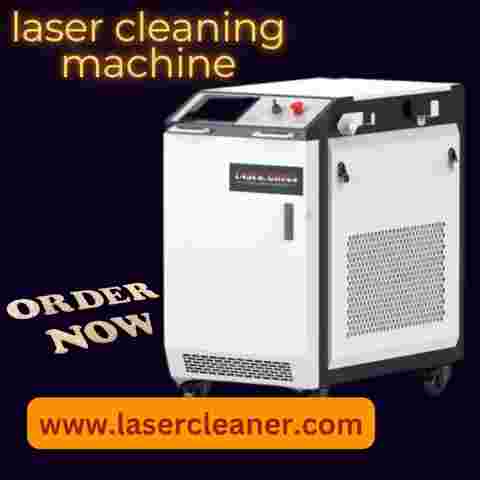
Industrial cleaning plays an important role in maintaining product quality, equipment performance, and production efficiency. Traditional cleaning methods often involve chemicals, abrasive materials, or manual labor, which can require additional time and maintenance. Modern laser technology offers a more advanced approach to surface preparation through precision-based cleaning.
A laser cleaning machine uses a concentrated laser beam to remove rust, paint, oil, grease, oxidation, and other unwanted contaminants from different surfaces. It provides manufacturers with a controlled cleaning process that supports consistent results across various industrial applications.
How Does Laser Cleaning Technology Work?
Laser cleaning works by directing high-energy laser pulses onto a contaminated surface. The laser energy interacts with unwanted materials, causing them to separate from the underlying surface through processes such as ablation and thermal effects.
The operator can adjust parameters such as laser power, scanning speed, frequency, and pulse duration according to the material and type of contamination. This allows the equipment to handle different cleaning requirements while maintaining control over the treatment area.
Depending on the application, manufacturers can choose pulsed or continuous-wave laser systems. Pulsed systems are commonly used for delicate surfaces and precision cleaning, while continuous-wave systems are suitable for certain heavy-duty industrial cleaning operations.
Applications Across Different Industries
Laser cleaning technology is widely used in manufacturing, automotive production, aerospace, metal fabrication, and equipment maintenance.
In the automotive industry, it helps remove rust, paint, and surface residues from metal components before welding, coating, or restoration. Manufacturers can also use it to prepare connecting surfaces for improved processing consistency.
In metal fabrication workshops, laser systems clean steel, aluminum, and other compatible materials before further manufacturing operations. They are also useful for removing oxidation from metal parts and preparing surfaces for protective treatments.
The technology has applications in mold cleaning as well. It can remove accumulated residues from industrial molds, helping manufacturers maintain production quality and reduce cleaning downtime.
Choosing the Right Equipment
Selecting suitable cleaning equipment requires understanding the materials, contamination levels, and production environment. Different applications may require different laser power levels and operating configurations.
For example, light rust removal and precision cleaning may require a different setup from removing thick paint or heavy industrial contamination. Businesses should also consider the working area, portability, cooling system, control interface, and availability of technical support.
A reliable supplier should provide clear equipment specifications, operating instructions, safety guidance, and after-sales assistance. These factors help businesses select a suitable system for their long-term production requirements.
Safety and Maintenance Considerations
Although laser technology offers a controlled cleaning process, proper safety measures are essential. Operators should use appropriate laser safety eyewear, protective enclosures where required, warning signs, and suitable ventilation or fume extraction systems.
Regular maintenance also supports consistent performance. Cleaning optical components according to manufacturer instructions, checking cooling systems, inspecting cables, and keeping the equipment free from dust can help maintain operational reliability.
Employees should receive proper training before operating industrial laser equipment, especially when working with high-power laser sources.
Why Businesses Are Adopting Laser Cleaning
Manufacturers are increasingly exploring laser-based solutions as production requirements become more demanding. The ability to clean selected areas with controlled laser energy makes this technology suitable for both specialized workshops and larger industrial facilities.
A modern laser cleaning machine can support surface preparation, restoration, maintenance, and manufacturing processes. Businesses can select equipment according to their daily workload, material requirements, and production targets.
Final Thoughts
Laser cleaning technology is changing how industries approach surface preparation and contamination removal. From automotive components to metal fabrication and industrial maintenance, it offers a modern solution for various cleaning applications.
Choosing the right equipment, understanding its operating requirements, and following proper safety procedures are essential for achieving reliable results. For businesses looking to modernize their cleaning processes, investing in a suitable laser cleaning machine can be a valuable step toward more efficient industrial operations.

 English
 French
 Spanish
 Portuguese
 Deutsch
 Turkish
 Dutch
 Italiano
 Russian
 Romaian
 Portuguese (Brazil)
 Greek