


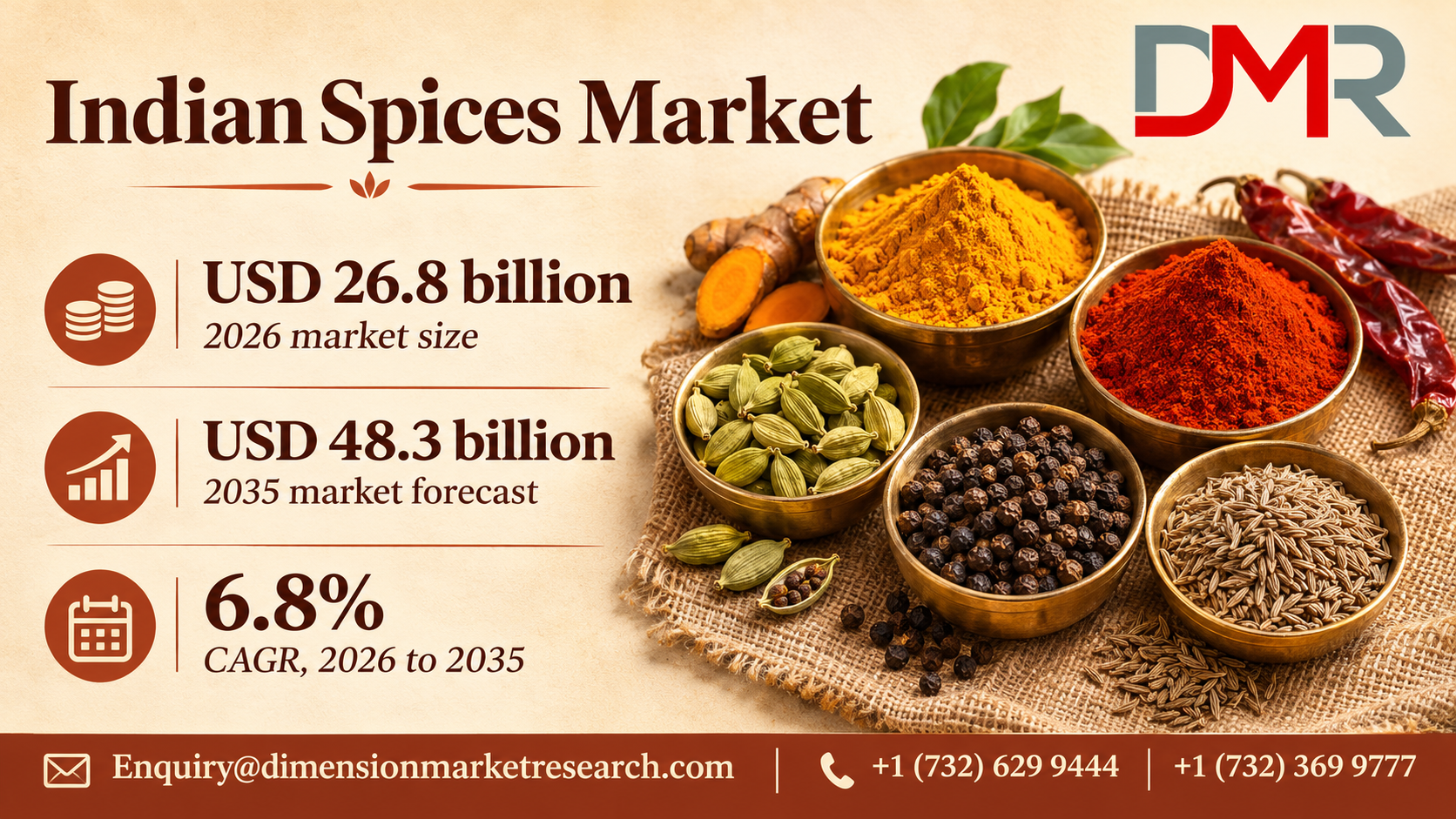
According to Dimension Market Research, the Indian Spices Market is estimated at USD 26.8 billion in 2026 and projected to reach USD 48.3 billion by 2035, at a CAGR of 6.8%. Household cooking remains the foundation of demand, while packaged food manufacturers and foodservice operators are creating opportunities for suppliers that can deliver consistent blends, powders, and seasonings at scale.
Pure spices and powders lead demand
Pure spices account for an estimated 64.0% of the market by product type in 2026. Turmeric, chilli, cumin, and coriander are everyday ingredients for households and are widely used by food manufacturers. Recipe-specific blends such as sambhar masala and chole masala serve a different purchasing need. They reduce preparation time and give brands a way to tailor their products to particular dishes or regional preferences.
Powder accounts for an estimated 62.0% of the market by form, while curries lead the application breakdown with a 38.0% share in 2026. Ground spices save preparation time at home and allow kitchens and factories to measure ingredients consistently. Whole spices and pastes also serve applications where the recipe depends on texture or how the ingredients release their aroma during cooking.
Get a Free Sample of the Indian Spices Market Report
Review the sample to see how the study defines the market and separates demand by product type, application, form, and distribution channel. The breakdown can help manufacturers evaluate where a new masala, seasoning, or processed ingredient fits.
https://dimensionmarketresearch.com/request-sample/indian-spices-market/
Packaged foods and foodservice create demand for consistent blends
Snack, sauce, frozen meal, and instant food manufacturers need seasonings that produce the intended taste across batches. For their suppliers, specifications such as pungency, particle size, and moisture can matter as much as the choice of spice. Customized blends give ingredient manufacturers an opportunity to develop products around those specifications and serve customers across multiple food categories.
Restaurants, caterers, and cloud kitchens buy in larger formats than households. A standardized masala can shorten preparation and help a restaurant chain serve the same dish consistently across locations. This creates room for foodservice packs and blends designed around the recipes and volumes of institutional kitchens.
Offline retail remains central to distribution
Offline channels represent an estimated 86.0% of distribution in 2026. Neighborhood stores and supermarkets give household buyers regular access to frequently purchased spices, while wholesalers and direct sales serve buyers ordering larger quantities. Digital grocery and quick commerce offer another route for specialty products, regional blends, and trial packs. For brands testing an assortment, online channels can reveal demand for products that may initially have limited shelf space.
Crop volatility and export requirements shape supplier competition
Changes in crop output and raw material prices can pressure margins, especially for brands selling at established retail price points. Exporters face an additional challenge. Testing requirements and buyer specifications vary by destination and product. Traceable sourcing, quality testing, and documented processing help suppliers demonstrate that shipments meet the buyer’s requirements.
The report cites USD 4.43 billion in Indian exports of spices and spice products in 2025 to 2026. It identifies extracts, oleoresins, tested powders, and customized blends as opportunities for exporters looking to sell higher-value ingredients. The competitive landscape includes Tata Consumer Products, Everest, Aachi Masala, Synthite Industries, and Kancor Ingredients. Consumer brands compete on distribution and recognition, while ingredient suppliers compete on processing capability, traceability, and customization.
View the Indian Spices Market Report and Purchase Options
Use the full report to compare demand for pure spices and blends, assess distribution options, and review opportunities in foodservice, packaged foods, and export ingredients. Purchase options are available through the report page. The direct checkout URL could not be verified.
https://dimensionmarketresearch.com/checkout/indian-spices-market/
Frequently Asked Questions
1. How large is the Indian Spices Market?
DMR estimates the market at USD 26.8 billion in 2026 and projects it to reach USD 48.3 billion by 2035.
2. What is the projected CAGR of the Indian Spices Market?
The market is forecast to grow at a CAGR of 6.8% from 2026 to 2035.
3. Which product type leads the Indian Spices Market?
Pure spices lead the product breakdown with an estimated 64.0% share in 2026.
4. Which application accounts for the largest share?
Curries lead the application segment with an estimated 38.0% share in 2026.
5. Which distribution channel leads the market?
Offline distribution leads with an estimated 86.0% share in 2026.
Conclusion
Household demand for pure spices anchors the Indian market, while packaged foods and foodservice are creating demand for blends that deliver consistent flavor with less preparation. Growth opportunities through 2035 include recipe-specific masalas for consumers and ingredients tailored to industrial and export buyers. For suppliers pursuing those opportunities, reliable sourcing and repeatable processing will matter as much as expanding the product range.

 English
 French
 Spanish
 Portuguese
 Deutsch
 Turkish
 Dutch
 Italiano
 Russian
 Romaian
 Portuguese (Brazil)
 Greek