


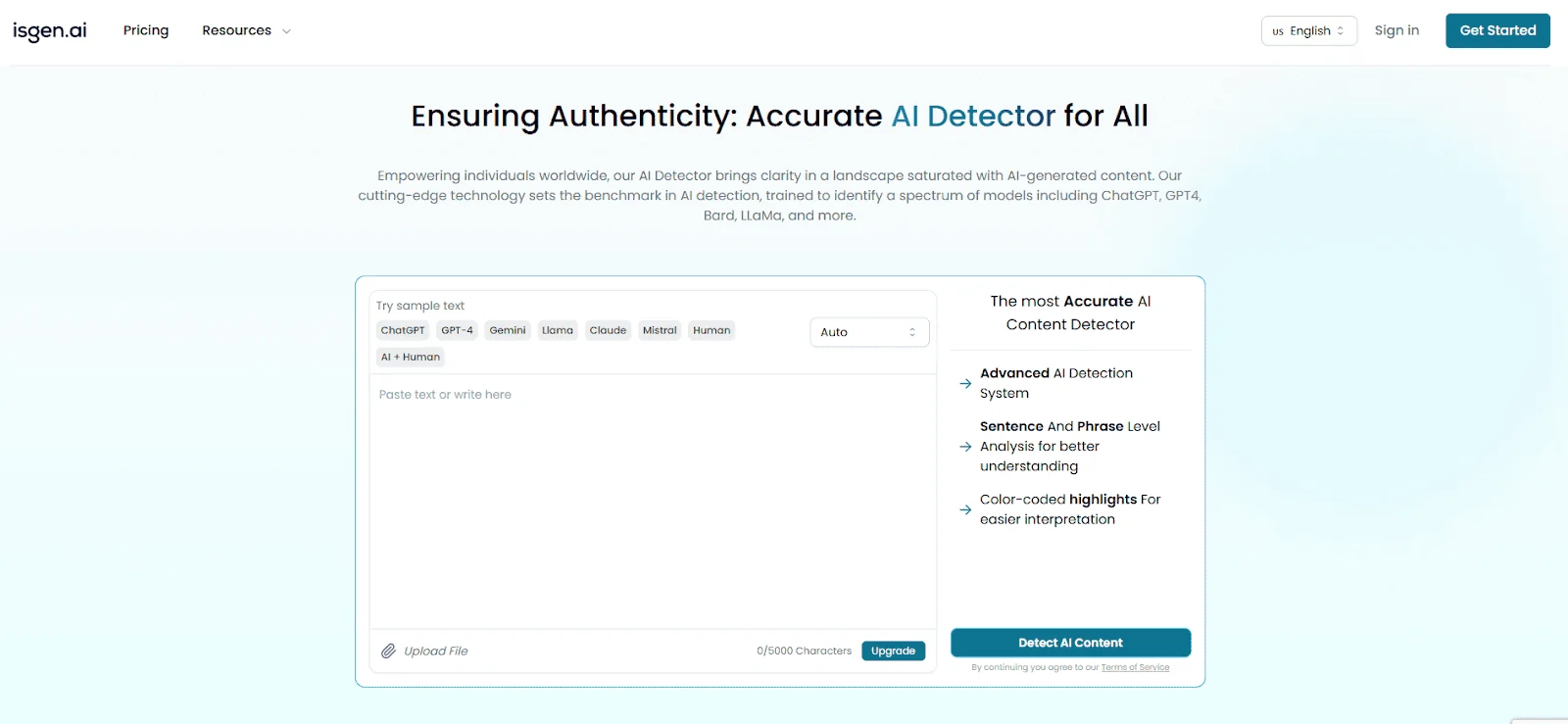
Your professor sends back your essay with a note: "This looks machine-written." You wrote every word yourself. Or you are an editor who suspects a freelancer's German article came straight from a chatbot, but you cannot prove it. In both cases, an ai detector german can offer a starting point, though only if you understand what it can and cannot tell you. This guide explains how these tools work, why German text is a special case, how to read the results sensibly, and what to do when a score feels wrong.
How AI Detection Works
Detection tools do not "know" who wrote a text. They look for statistical patterns that tend to appear in machine-generated writing:
-
Predictability. AI models choose likely next words, so their sentences often feel smooth but safe.
-
Uniform rhythm. Human writers vary sentence length without noticing. Generated text is often more even.
-
Generic phrasing. Broad statements, repeated structures, and few concrete details are common signals.
The result is a probability, not a verdict. A score of 80 percent does not mean 80 percent of the text was written by a machine. It means the writing resembles patterns the tool associates with AI.
Why German Needs Extra Care
Many detectors were trained mostly on English. German brings its own challenges:
-
Compound words. Long constructions like "Datenschutzgrundverordnung" behave differently from English vocabulary.
-
Formal register. Academic and business German is often structured and impersonal, which can look "machine-like" to a poorly calibrated tool.
-
Grammar and word order. Verb placement and case endings change how sentences are built, so patterns learned from English may not transfer well.
That is why people searching for a ki detector deutsch should look for tools that state clearly that German is supported, rather than assuming an English tool will do the job. A detector built or tested for the language will generally handle these quirks better, though none is perfect.
How to Read Your Results
Treat the score as one signal
A single number should never decide anything. Use it to decide where to look more closely.
Check the highlighted passages
Many tools mark the sections that triggered the flag. Read those parts yourself. Do they sound like the writer? Do they contain specific details, opinions, or examples only someone with first-hand knowledge would include?
A realistic example
A student submits a thesis chapter and gets a 65 percent AI score. The chapter is a literature review with long, neutral summaries, a style that naturally reads as formulaic. The flagged paragraphs contain no personal analysis. The student adds their own evaluation of each source, varies the sentence structure, and the score drops. Nothing was hidden; the writing simply became more their own.
Steps for Checking a Text Responsibly
-
Run the text through more than one tool if the decision matters.
-
Compare with earlier work from the same writer. Sudden shifts in style are more telling than a score.
-
Look for factual errors. AI text can include invented sources or confident mistakes.
-
Ask the writer. A short conversation about their process often reveals more than software.
-
Document your reasoning instead of relying on the number alone.
Common Mistakes to Avoid
Treating a detector as proof. False positives happen, especially with formal, technical, or non-native writing.
Testing very short texts. A few sentences give too little data. Longer samples produce steadier results.
Ignoring edits. Text that was generated and then heavily revised may score unpredictably.
Skipping the human read. Your own judgment about voice, logic, and detail still matters most.
Quick Checklist
-
The tool supports German
-
The sample is long enough
-
Flagged passages were read manually
-
More than one signal was considered
-
No accusation was based on a score alone
Frequently Asked Questions
Are AI detectors 100 percent accurate?
No. They estimate likelihood and can produce both false positives and false negatives.
Can a detector flag text I wrote myself?
Yes. Clear, formal, or heavily structured writing sometimes triggers a flag.
Does a low score guarantee a human wrote it?
No. Edited AI text can pass, so a low score is not a guarantee either.
Do detectors work as well in German as in English?
It depends on the tool. Results are generally more reliable when the detector was designed and tested for German.
How can I make my writing sound more natural?
Add personal examples, specific details, and your own opinions, and vary your sentence length.
Final Thoughts
An AI detector is a helpful signal, not a judge. Use it to start a closer look, pair it with your own reading, and be fair to the writer, especially when the language is German and the tools are still catching up.
Found this useful? Share it with a teacher, editor, or student who deals with AI-written content, or bookmark it for the next time a score surprises you.

 English
 French
 Spanish
 Portuguese
 Deutsch
 Turkish
 Dutch
 Italiano
 Russian
 Romaian
 Portuguese (Brazil)
 Greek