


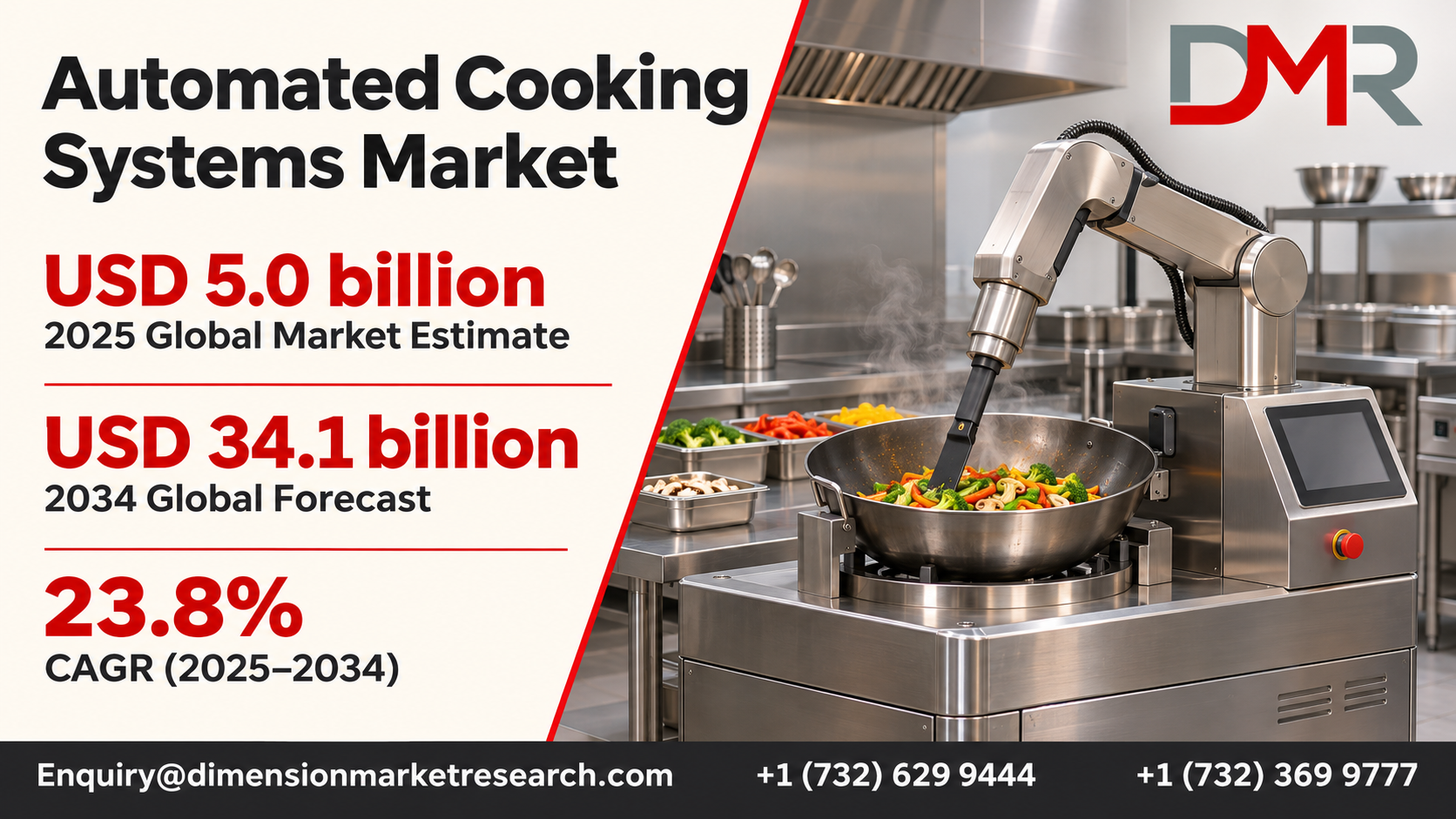
The global Automated Cooking Systems Market is projected to grow as restaurants and institutional kitchens look for ways to maintain consistent output amid staffing pressure. According to Dimension Market Research, the market was estimated at USD 5.0 billion in 2025 and is projected to reach USD 34.1 billion by 2034, at a 23.8% CAGR over the forecast period. These figures come from the report’s Market Overview, Key Takeaways, and FAQs.
For a quick-service restaurant, the immediate opportunity may be automating a repetitive task such as frying. For a school or healthcare kitchen, the priority may be preparing large batches on schedule with consistent results. Both applications show why the value of automation depends on the work it takes on and how well it fits the kitchen.
What Are Automated Cooking Systems?
Automated cooking systems use equipment and software to carry out or control steps in food preparation. The market includes robotic cooking stations, smart ovens, and integrated kitchen platforms. Depending on the system, sensors can monitor temperature, software can control cooking cycles, and robotics can handle tasks such as stirring, mixing, grilling, or frying. That range lets buyers consider equipment for a single station or automation across multiple steps.
Get a Free Sample of the Automated Cooking Systems Market Report
Review the sample to see how the report defines the market and whether its segmentation and company coverage fit your equipment, procurement, or investment research.
https://dimensionmarketresearch.com/request-sample/automated-cooking-systems-market/
Why Restaurants and Institutional Kitchens Are Investing
Labor shortages and the need for repeatable results are encouraging quick-service restaurants, food chains, and institutional kitchens to look at automation. A restaurant chain can evaluate whether automating a high-volume step improves consistency across locations. An institutional kitchen can assess whether batch cooking equipment fits its meal schedules and production volumes. Residential adoption addresses a different need, with connected appliances offering conveniences such as guided recipes, portion control, and automated cooking cycles.
Installation and maintenance costs remain barriers, especially for smaller operators. Retrofitting an existing kitchen can also be difficult, and connected equipment introduces cybersecurity and data privacy considerations. For buyers, those constraints make the choice of workflow as important as the choice of equipment. A pilot can start with a measurable problem, such as inconsistent batch times, and track throughput, staff time, and maintenance needs before a wider rollout.
Asia Pacific Leads in Share and North America in Growth
Asia Pacific was projected to lead with 44.6% of global market revenue in 2025. Japan illustrates how local conditions shape product design. Limited urban kitchen space supports compact systems, while labor constraints give foodservice operators a reason to evaluate automation. The report also notes that equipment designed around familiar dishes can help manufacturers address local cooking preferences.
North America is projected to record the fastest regional growth. DMR links the outlook to foodservice digitalization, staffing shortages, and rising labor costs in the United States and Canada. In the U.S., restaurants, schools, and cafeterias are among the operations exploring automation. For suppliers, those different customers offer different entry points, from a repeatable cooking station in a chain to batch preparation in an institutional kitchen.
How Automated Cooking System Suppliers Compete
The report covers providers including Miso Robotics, Moley Robotics, Picnic Works, Botinkit, and Richtech Robotics. It identifies modular equipment and task-specific automation as areas of competition. When comparing systems for a commercial kitchen, buyers can start with practical questions about menu compatibility, the space needed for installation, and ongoing service. Those details help determine whether the equipment can deliver the intended operating benefit at a single site or across a chain.
Explore the Complete Automated Cooking Systems Market Analysis
Use the complete report to assess commercial and residential applications, compare regional demand, and review the competitive landscape before prioritizing equipment categories or markets.
https://dimensionmarketresearch.com/checkout/automated-cooking-systems-market/
Frequently Asked Questions
1. How large is the global Automated Cooking Systems Market?
DMR estimates the market at USD 5.0 billion in 2025 and projects it will reach USD 34.1 billion by 2034.
2. What is the projected growth rate?
DMR reports a projected CAGR of 23.8% from 2025 to 2034.
3. Which region has the largest market share?
Asia Pacific was projected to lead with 44.6% of global revenue in 2025.
4. Which region is projected to grow fastest?
North America is projected to post the highest regional CAGR, supported by demand for labor-efficient foodservice operations.
5. What is slowing adoption of automated cooking systems?
High installation and maintenance costs, difficulties retrofitting existing kitchens, and cybersecurity concerns around connected equipment can slow adoption.
Conclusion
The outlook through 2034 reflects growing demand for consistent cooking results and equipment that eases pressure on kitchen staff. For foodservice operators, the strongest starting point is a frequently repeated task with a measurable operating cost. For suppliers, modular designs offer a way to address that task within the space and budget of an existing kitchen.
Related Cooking Technology Market Insights
The Digital Cooking Technology Market Size is projected to rise from USD 14.4 billion in 2025 to USD 53.8 billion by 2034, at a 15.8% CAGR. The report covers appliances and technologies that support features such as real-time temperature control and remote monitoring.
The Smart Cooking Technology Market Share analysis projects induction-based cooking to account for 45.0% of the cooking-method segment in 2025. The report also tracks developments in app-controlled appliances, sensor automation, and AI-enabled cooking assistance.
The Connected Cooking Devices Market Growth outlook identifies demand for remote monitoring, cooking alerts, and smart-home integration. DMR expects residential users to account for the largest application share in 2025.

 English
 French
 Spanish
 Portuguese
 Deutsch
 Turkish
 Dutch
 Italiano
 Russian
 Romaian
 Portuguese (Brazil)
 Greek