


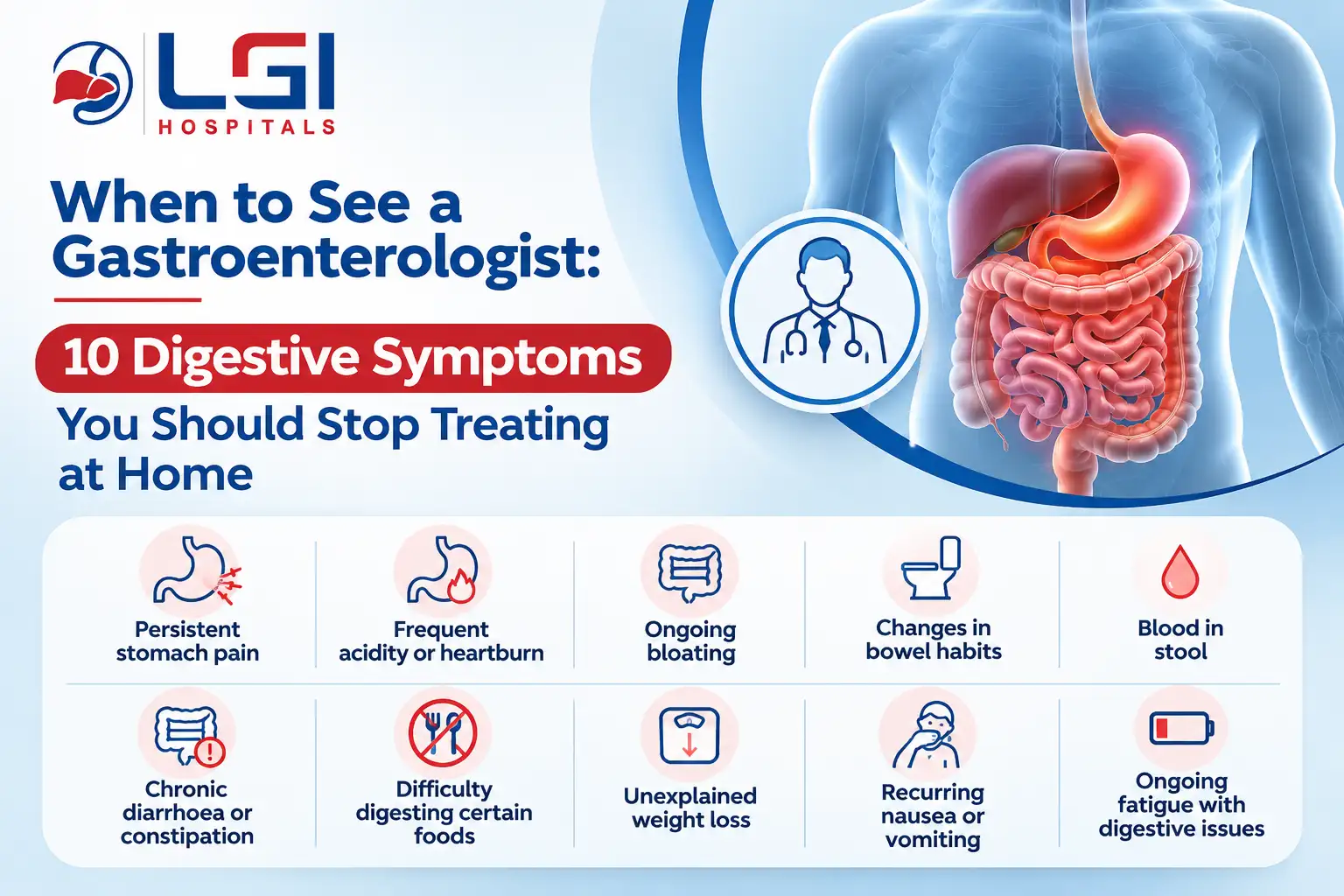
Acidity after a heavy dinner, a bloated stomach after a wedding meal, or a day of loose motions: most of us handle these with an antacid, jeera water or a few days of khichdi, and usually that works. The problem starts when the same symptom keeps coming back for weeks, and the home remedy becomes a habit that hides what is actually going on.
A gastroenterologist is a doctor who specialises in the digestive system: the food pipe (oesophagus), stomach, small and large intestine, liver, gallbladder, bile ducts and pancreas. Many digestive conditions are easy to treat when caught early and much harder once they have been ignored for months. This guide lists the symptoms that deserve a specialist's opinion rather than another round of self-treatment.
What does a gastroenterologist actually treat?
Gastroenterology is broadly split into two sides. A medical gastroenterologist diagnoses and treats conditions with medicines and endoscopic procedures: acid reflux, ulcers, IBS, fatty liver, hepatitis, pancreatitis, bile duct stones and gut bleeding. A surgical gastroenterologist operates when surgery is needed: gallbladder removal, hernia repair, colon and pancreatic surgery, and GI cancers. Hospitals that have both teams under one roof can move a patient from diagnosis to treatment without repeated referrals.
10 symptoms that need a specialist, not another home remedy
1. Acidity or heartburn more than twice a week
Occasional acidity is common. Burning behind the chest bone several times a week, sour fluid coming up into the mouth, or acidity that returns as soon as you stop antacids can point to gastro-oesophageal reflux disease (GERD). Long-standing reflux can inflame and scar the food pipe, so it needs proper evaluation.
2. Difficulty or pain while swallowing
Food that feels stuck in the chest, pain while swallowing, or needing water to push food down is never something to wait out. It can be caused by a narrowing, inflammation or a motility problem in the oesophagus, and it needs to be examined.
3. Weight loss or loss of appetite you can't explain
Losing weight without dieting, feeling full after a few bites, or a steady drop in appetite over a few weeks are signs a doctor should investigate, especially after the age of 40.
4. Blood in stool, black stool or vomiting blood
Bright red blood can come from piles or a fissure, but it can also come from higher up in the bowel. Black, tarry, sticky stool or vomiting blood (or material that looks like coffee grounds) can mean bleeding in the stomach or food pipe. Vomiting blood or passing large amounts of black stool is an emergency. Go to a hospital immediately.
5. A change in bowel habits that lasts more than a few weeks
New constipation, loose motions, alternating between the two, a feeling of incomplete emptying, or thinner stools that persist beyond three or four weeks should be checked, even if there is no pain.
6. Yellow eyes or skin, or dark urine
Jaundice is a sign, not a disease. It can come from hepatitis, a blocked bile duct due to stones, alcohol-related liver damage or, less commonly, a tumour. The treatment depends entirely on the cause, which is why jaundice should be evaluated by a specialist rather than treated with home remedies alone.
7. Severe upper abdominal pain that spreads to the back
Pain in the upper belly that radiates to the back, often with vomiting, can be caused by pancreatitis or gallstones. Pain under the right ribs after oily meals is a classic gallbladder pattern. Severe, constant pain needs same-day medical attention.
8. Bloating, gas and cramps that keep coming back
Irritable bowel syndrome (IBS), food intolerances such as lactose intolerance, celiac disease and bacterial overgrowth can all cause recurring bloating. A gastroenterologist can tell these apart. IBS is diagnosed partly by ruling other things out, which is not something you can do at home.
9. A diagnosis of fatty liver, especially with diabetes or obesity
Fatty liver is often found by chance on an ultrasound and then ignored. In people with diabetes, high triglycerides or excess weight, it can progress silently to inflammation and scarring. A specialist can check how much damage there is and what can still be reversed.
10. A family history of stomach or colon cancer
If a parent or sibling has had a digestive cancer, ask a gastroenterologist when you should start screening and how often. Screening finds problems such as polyps before they turn into something serious.
| When to go to the emergency department straight away: vomiting blood, heavy black stools, fainting, severe abdominal pain with a hard belly, or jaundice with confusion or drowsiness. |
What happens at your first gastroenterology visit?
Most first consultations follow a similar path. The doctor takes a detailed history of your symptoms, diet, medicines and family history, then examines your abdomen. Depending on what they suspect, they may advise blood tests such as a complete blood count and liver function test, a stool test, an abdominal ultrasound, or an endoscopic examination.
An endoscopy test lets the doctor see the inside of your food pipe, stomach and first part of the small intestine through a thin flexible camera. A colonoscopy does the same for the large intestine. Both are usually done as day-care procedures, often under sedation, and small tissue samples (biopsies) can be taken during the same sitting. Before an upper endoscopy you will usually be asked to fast for several hours. Before a colonoscopy you will be given a bowel preparation to drink. Always follow the instructions your own hospital gives you.
How to prepare for the appointment
• Write down when the symptom started, how often it happens and what makes it better or worse.
• Carry a list of every medicine and supplement you take, including painkillers and antacids.
• Bring old reports: blood tests, ultrasound, CT scans and any previous endoscopy findings.
• Note any family history of liver disease, ulcers or digestive cancers.
• Write down your questions so you don't forget them in the consultation room.
Choosing the right gastroenterologist in Nagpur and Central India
Nagpur is a referral centre for patients from across Vidarbha and neighbouring parts of Madhya Pradesh, Chhattisgarh and Telangana, so many families travel in for specialist care. When you choose where to go, a few practical points matter more than advertisements:
• Endoscopy and diagnostics in-house: fewer trips between labs and clinics, and faster answers.
• Medical and surgical gastroenterology together: if a gallstone, hernia or tumour needs surgery, the same team can plan it.
• 24x7 emergency and ICU support: GI bleeding, severe pancreatitis and liver failure can't wait for OPD hours.
• Experience with liver and pancreas conditions: these are more complex than routine acidity and need specialised follow-up.
For patients in the region, LGI Hospitals in Dhantoli brings these together: medical and surgical gastroenterology, radiology and pathology, and intensive care under one roof. If your symptoms match any of the ten above, booking a consultation with an experienced gastroenterologist in Nagpur is a far better next step than another month of self-medication.
FAQs
Do I need a referral to see a gastroenterologist?
In most private hospitals in India you can book directly. Your family doctor's notes and reports are still useful to bring.
Is a gastroenterologist different from a general physician?
Yes. A general physician treats a wide range of conditions. A gastroenterologist has additional specialist training in digestive and liver diseases and performs procedures such as endoscopy, colonoscopy and ERCP.
Is endoscopy painful?
Most patients feel only mild discomfort, and sedation is commonly used. A sore throat or some bloating for a few hours afterwards is normal.
Can acidity be serious?
Occasional acidity usually isn't. Frequent acidity, acidity with weight loss or difficulty swallowing, or acidity that doesn't respond to medicine should be evaluated.
This article is for general information only and is not a substitute for medical advice. Please consult a qualified doctor about your symptoms.

 English
 French
 Spanish
 Portuguese
 Deutsch
 Turkish
 Dutch
 Italiano
 Russian
 Romaian
 Portuguese (Brazil)
 Greek