


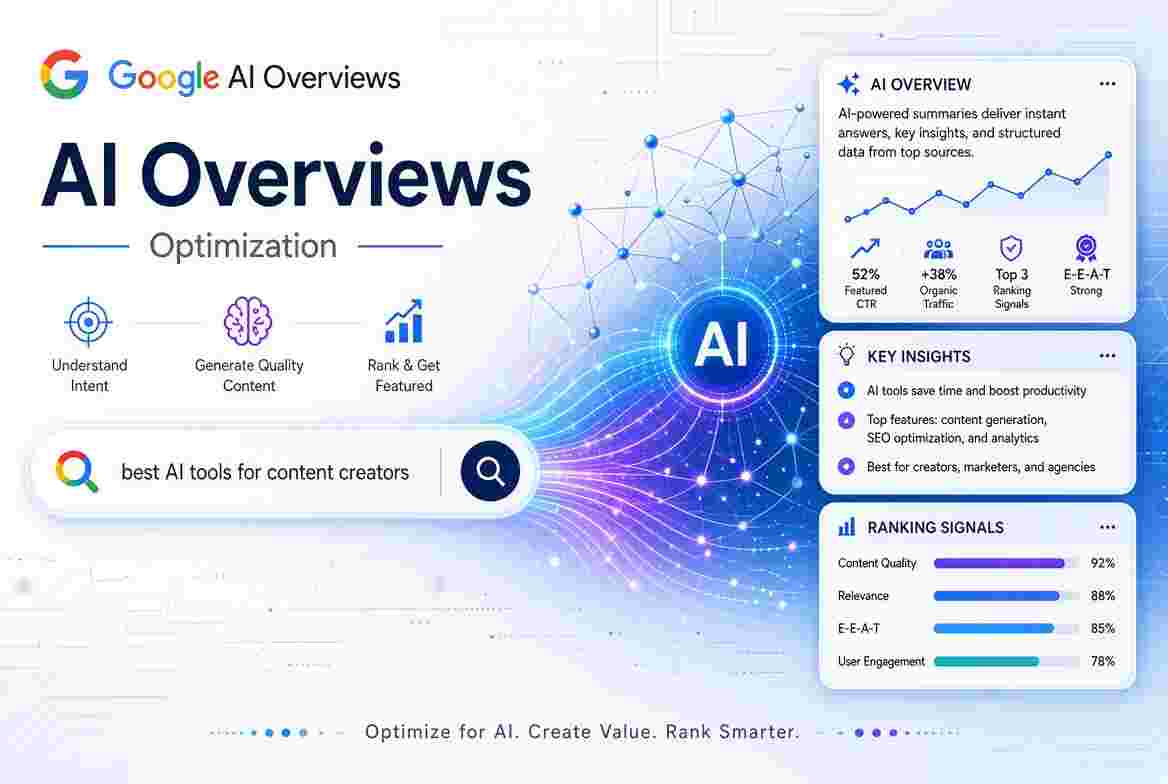
Search engine optimization has always evolved alongside changes in search technology. From keyword-based rankings to mobile-first indexing, businesses have continuously adapted their SEO strategies to remain visible.
Today, Google AI Overviews are introducing another major change.
Instead of showing only traditional search listings, Google can generate AI-powered summaries that answer user questions and provide links to supporting sources.
This creates an important question for businesses: Is traditional SEO still relevant, or should companies focus entirely on AI search optimization?
The answer is that traditional SEO remains essential, but businesses should expand their strategies to account for AI-powered search experiences.
Let's explore the differences.
What Is Traditional SEO?
Traditional SEO is the process of improving a website's visibility in organic search results.
It involves optimizing website content, technical performance, backlinks, user experience, and site structure to help search engines understand and rank relevant pages.
Common traditional SEO activities include:
- Keyword research.
- On-page optimization.
- Technical SEO.
- Link building.
- Content marketing.
- Local SEO.
- Website performance optimization.
The objective is to help relevant pages appear when users search for information, products, or services.
What Are Google AI Overviews?
Google AI Overviews are AI-generated summaries displayed within selected Google Search results.
They help users explore topics by combining relevant information into a summarized answer.
These summaries may reference supporting websites through links.
Unlike a conventional organic listing, a supporting source is selected in the context of an AI-generated response.
For businesses, this means search visibility can involve both traditional rankings and opportunities to be referenced in AI-powered search experiences.
Google AI Overviews vs Traditional SEO: Key Differences
1. Search Result Presentation
Traditional SEO focuses on individual website listings within organic search results.
AI Overviews provide an AI-generated summary that may include links to multiple supporting sources.
2. Search Intent
Traditional SEO often targets keywords and their associated search intent.
AI search optimization also requires understanding natural-language questions, conversational queries, and related information needs.
3. Content Structure
Traditional SEO benefits from optimized headings, relevant keywords, internal links, and useful content.
Content designed for AI search should also provide clear explanations, direct answers, accurate facts, and logical organization.
4. Visibility Opportunities
Traditional SEO measures visibility through organic impressions, rankings, and clicks.
AI Overviews create additional visibility opportunities through source attribution and references within generated summaries.
5. Performance Measurement
Traditional SEO reporting commonly includes rankings, impressions, clicks, and conversions.
AI search performance requires a broader view of search presence, branded queries, referrals where measurable, and business outcomes.
| Feature | Traditional SEO | Google AI Overviews |
|---|---|---|
| Search presentation | Organic listings | AI-generated summaries with supporting links |
| Content focus | Relevance and usefulness | Relevance, usefulness, and clear supporting information |
| Search queries | Keywords and phrases | Keywords and conversational questions |
| Visibility | Search result positions | Potential source inclusion |
| Measurement | Rankings, clicks, impressions | Search performance and measurable AI-related referrals where available |
Does Traditional SEO Still Matter in the AI Search Era?
Absolutely.
Google's guidance for AI features in Search continues to emphasize established SEO fundamentals.
Websites still need to be crawlable, indexable, eligible to show snippets, and genuinely helpful.
Businesses should not abandon traditional SEO in favor of untested AI-specific tricks.
Instead, they should improve their existing SEO strategy.
For example, a business that already has strong technical SEO, useful service pages, and trustworthy content has a better foundation for adapting to AI-powered search.
7 Ways to Adapt Your SEO Strategy for Google AI Overviews
1. Expand Keyword Research Into Question Research
Research the actual questions customers ask.
Use keyword research tools, customer support conversations, sales inquiries, and search suggestions to discover relevant topics.
Build content that answers these questions comprehensively.
2. Prioritize Helpful and Original Content
Avoid publishing articles that simply repeat information available everywhere.
Include practical examples, original insights, detailed explanations, and accurate information.
3. Improve Internal Linking
Connect related articles and service pages using descriptive anchor text.
Internal links help visitors navigate your website and provide context about relationships between your pages.
4. Strengthen Your Technical SEO
Review indexing, crawlability, canonicalization, mobile usability, and page performance.
Technical accessibility remains an important foundation.
5. Establish Brand Credibility
Create detailed company information, author profiles, service descriptions, customer reviews, and genuine industry references.
Your website should make it clear why customers should trust your business.
6. Use Structured Data Appropriately
Implement relevant schema markup that reflects the actual content on your website.
Do not treat schema as a guaranteed way to appear in AI Overviews.
7. Measure More Than Rankings
Monitor impressions, clicks, conversions, and changes in branded search behavior.
Look at the business value of your overall search presence rather than relying on a single ranking metric.
The Role of Generative Engine Optimization
Generative Engine Optimization, commonly called GEO, focuses on improving how a brand and its content are understood, discovered, and referenced by AI-powered search and answer platforms.
While traditional SEO remains central to Google Search visibility, GEO expands the strategy to consider platforms such as ChatGPT, Gemini, and Perplexity.
Businesses can benefit from combining SEO and GEO rather than treating them as competing strategies.
Explore Innosoft Works GEO Services to learn more about broader AI search visibility opportunities.
How Innosoft Works Helps Businesses Adapt
Innosoft Works helps businesses prepare for evolving Google Search experiences through practical optimization strategies.
Our Google AI Overviews optimization approach includes:
- Search query research.
- Technical eligibility assessments.
- People-first content improvements.
- Structured data reviews.
- Brand and entity visibility assessments.
- Search Console performance monitoring.
We focus on established SEO fundamentals instead of promising guaranteed AI placements.
Learn more about our Google AI Overviews Optimization Services.
Frequently Asked Questions
Is AI SEO replacing traditional SEO?
No. Traditional SEO remains important. AI SEO builds on its foundations while addressing new search and discovery experiences.
Can traditional SEO help with AI Overviews?
Yes. Strong technical SEO, helpful content, indexing eligibility, and website quality provide an important foundation.
What is the difference between SEO and GEO?
SEO focuses on improving search engine visibility. GEO expands optimization efforts toward discovery and references across generative AI platforms.
Should businesses invest in AI SEO in 2026?
Businesses that depend on organic discovery should evaluate how AI-powered search affects their audience and adapt their SEO strategies accordingly.
Will AI Overviews eliminate organic search traffic?
Not necessarily. Their impact varies by search topic and query. Businesses should monitor their own Search Console data and conversion performance.
Final Thoughts
Google AI Overviews are changing how information appears in search results, but they do not make traditional SEO obsolete.
Businesses should continue investing in technical SEO, high-quality content, relevant internal links, and genuine authority.
The strongest strategy combines proven SEO fundamentals with an understanding of AI-powered search.
Want to prepare your website for the future of Google Search?
Contact Innosoft Works to explore practical opportunities for improving your Google AI Overviews visibility.

 English
 French
 Spanish
 Portuguese
 Deutsch
 Turkish
 Dutch
 Italiano
 Russian
 Romaian
 Portuguese (Brazil)
 Greek