


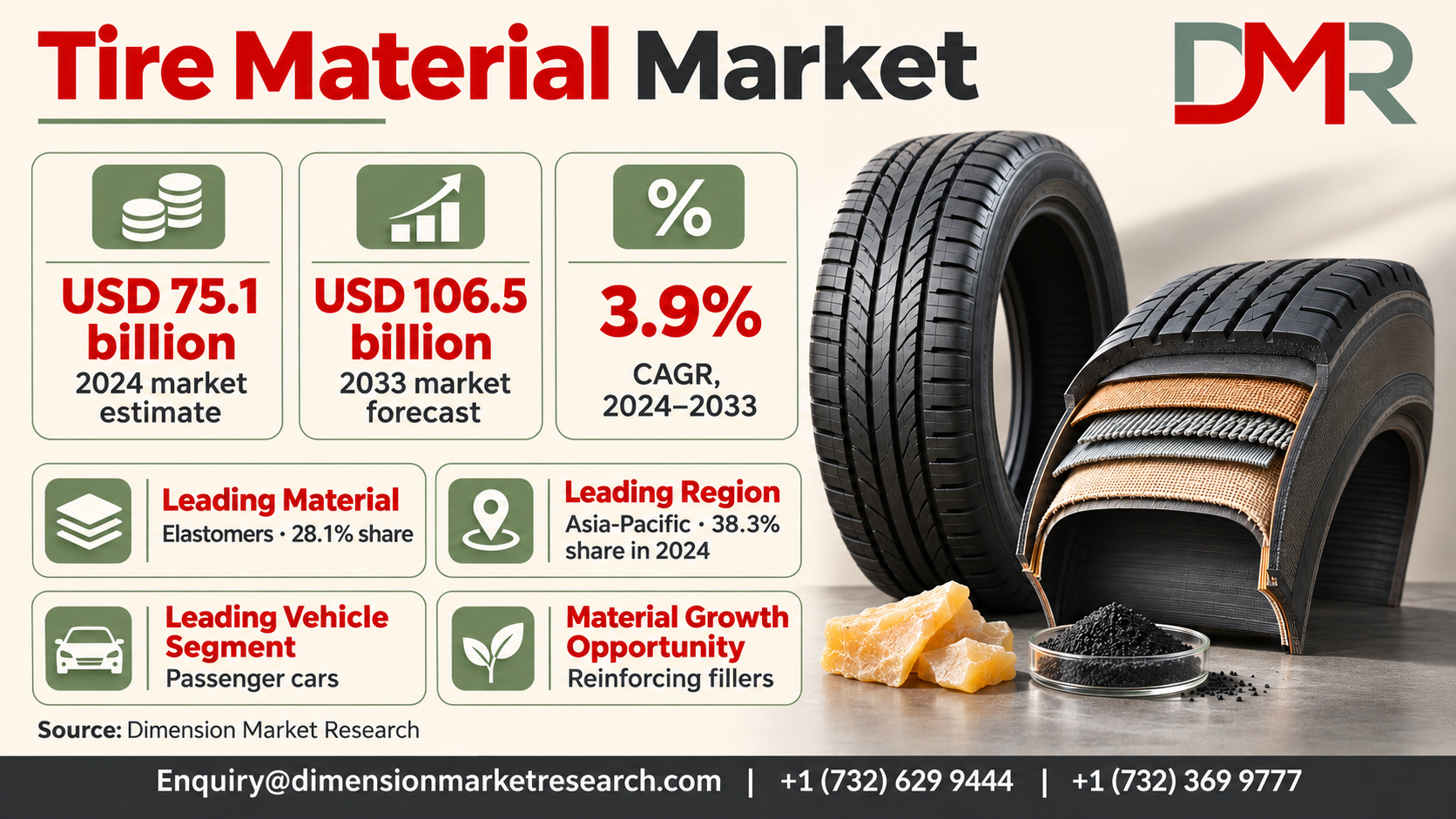
The Tire Material Market Share outlook reflects demand from new vehicle production, replacement tires and industrial equipment. According to Dimension Market Research, the global market was estimated at USD 75.1 billion in 2024 and is projected to reach USD 106.5 billion by 2033, with a reported CAGR of 3.9% for 2024 to 2033. Demand for tires that balance wear resistance, grip and lower rolling resistance is shaping which materials manufacturers use.
A passenger car tire has to balance ride comfort, handling and tread life. A tire for construction equipment has to carry heavy loads and withstand abrasive surfaces. Both require rubber compounds and reinforcement, but the operating conditions determine which properties matter most. That makes material selection a practical way for tire manufacturers to differentiate products across vehicle categories.
What Is the Tire Material Market?
The tire material market covers the inputs used to make tires, including natural and synthetic rubber, reinforcing fillers, chemicals, plasticizers, metal reinforcement and textile reinforcement. Rubber provides the flexible base of a tire compound. Fillers such as carbon black and silica help manufacturers adjust properties such as wear resistance and rolling resistance, while metal and textile reinforcement contribute to the tire’s structure. DMR analyzes these inputs across tire types and vehicle applications, including passenger cars and light commercial vehicles.
Get a Free Customized Sample of This or Any Other Market Research Report
https://dimensionmarketresearch.com/request-sample/tire-material-market/
Elastomers and Reinforcing Fillers Shape Tire Performance
DMR identifies elastomers as the leading material category, with a 28.1% market share. The category includes natural and synthetic rubber. Tire makers can adjust the composition of a rubber blend to meet different requirements for flexibility, grip and wear. For material suppliers, that creates opportunities to develop grades for specific applications, such as tires that need to withstand frequent use or reduce energy losses while rolling.
● Carbon black. Tire manufacturers use it to reinforce rubber compounds and improve wear resistance. That makes its performance relevant to products developed for long tread life.
● Silica. The report highlights silica in the development of compounds designed to reduce rolling resistance. For tire makers, the challenge is achieving that reduction while preserving the grip and durability expected for the application.
Passenger Car Tires and Replacement Demand Support Material Sales
Passenger cars were the leading vehicle segment in DMR’s 2024 analysis. Demand for passenger car tires reflects a mix of everyday requirements, including handling, ride comfort, affordability and longevity. Pneumatic tires led by tire type in the same analysis. Their widespread use across passenger vehicles, motorcycles, bicycles and heavy equipment supports demand for materials used in air-filled tire designs.
● Replacement tires. The report identifies rising replacement demand in emerging markets as a growth driver. Vehicles already in service continue to need tires as treads wear, creating demand alongside new vehicle production.
● Mining and construction equipment. DMR also points to machinery sales as a driver. Tires used on heavy equipment face different load and wear conditions from passenger car tires, creating demand for materials suited to those applications.
EV Tire Materials and Recycled Inputs Create New Opportunities
Electric vehicles are creating demand for compounds that address rolling resistance, tire noise and load capacity. Lower rolling resistance can help reduce the energy a vehicle uses in motion. For suppliers developing EV tire materials, the commercial opportunity lies in a compound’s ability to meet several requirements at once, including wear resistance and the ability to support the intended vehicle load.
DMR also highlights interest in recycled and bio-based inputs. In January 2023, The Goodyear Tire & Rubber Company unveiled a prototype tire containing 90% sustainable materials, as described in the report. In May 2023, Toyo Tire Corporation and the University of Toyama reported progress on catalysts that convert carbon dioxide into butadiene, an input for synthetic rubber. These examples show how development is taking place at both the finished-tire and raw-material stages.
Asia Pacific Leads Tire Material Demand as Input Costs Pressure Buyers
DMR identifies Asia Pacific as the leading region, supported by automotive demand and tire production in markets such as China and India. China’s manufacturing base and India’s domestic tire industry make both countries important to suppliers assessing where to develop customer relationships. Companies covered in the report include Orion Engineered Carbons, Chevron Corporation, China Petroleum & Chemical Corporation and LANXESS.
Price volatility in natural rubber and petroleum-based synthetic rubber can raise production costs and make pricing harder to manage. Developing and testing new compounds also adds costs, particularly when a new input needs to deliver the same performance consistently at production scale. For buyers evaluating alternative materials, supply consistency and qualification costs matter alongside the quoted price.
Explore the Complete Tire Material Market Analysis
https://dimensionmarketresearch.com/checkout/tire-material-market/
Frequently Asked Questions
What is the size of the global Tire Material Market?
DMR estimates the market at USD 75.1 billion in 2024 and projects it to reach USD 106.5 billion by 2033.
What is the projected Tire Material Market growth rate?
DMR’s market overview reports a CAGR of 3.9% from 2024 to 2033.
Which material type holds the largest market share?
Elastomers lead with a 28.1% share, supported by the use of natural and synthetic rubber in tire production.
Which region leads the global Tire Material Market?
Asia Pacific leads, with China and India contributing through automotive demand and tire manufacturing.
What is driving demand for advanced tire materials?
Demand for longer tread life, lower rolling resistance and EV-specific performance supports the use of advanced rubber compounds and fillers.
Conclusion
Passenger car production and replacement demand provide a base for tire material sales through 2033. EV tire development and interest in recycled and bio-based inputs give suppliers opportunities to develop new compounds. Commercial adoption will depend on whether those materials meet tire makers’ requirements for performance, consistent supply and cost.

 English
 French
 Spanish
 Portuguese
 Deutsch
 Turkish
 Dutch
 Italiano
 Russian
 Romaian
 Portuguese (Brazil)
 Greek