


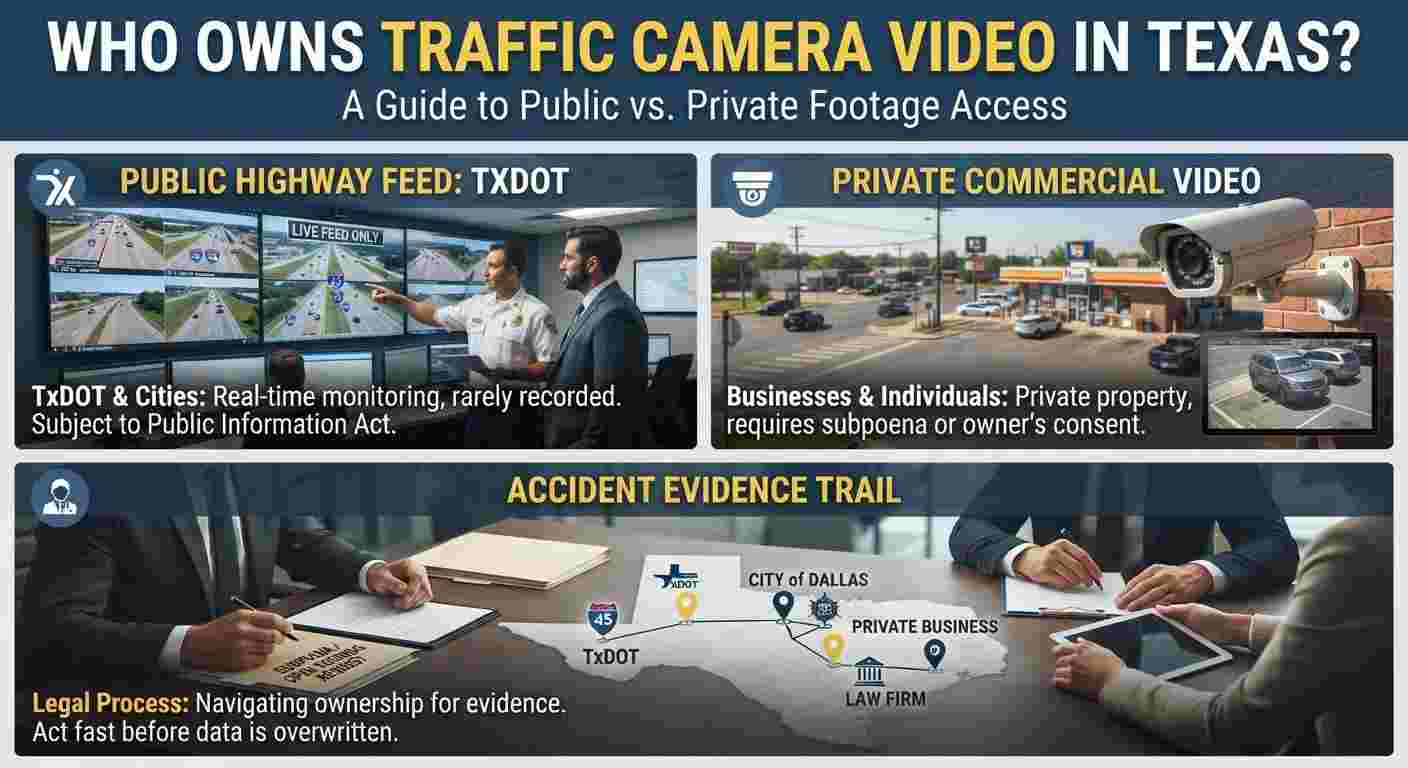
After a crash, many people assume there's one central place to request video. They picture a single office somewhere that holds every traffic camera recording in the state. In reality, the cameras you see along Texas roads belong to many different owners, and each one has its own rules for storing and releasing footage.
Knowing who owns a camera is the first step in getting its video. Contact the wrong agency, and you may lose days you don't have. Here's a breakdown of who typically owns the cameras near Texas roads and how to approach each one.
Why Ownership Matters
Every camera owner decides whether its cameras record, how long footage is kept and who can access it. A highway camera run by a state agency follows different procedures than a gas station camera managed by a store owner.
That's why figuring out how to get traffic camera footage in texas usually starts with a simple question: whose camera is it? Once you know that, you'll know who to contact and what kind of request to make.
State Cameras: The Texas Department of Transportation
The Texas Department of Transportation (TxDOT) operates many cameras along state highways and interstates. These cameras are often connected to regional traffic management centers that monitor congestion, crashes and road hazards.
A few things to know about state highway cameras:
- Many are used mainly for live monitoring and may not save video
- When footage is recorded, it may only be kept for a short time
- Requests generally go through a public information request process
- Some regions share camera operations with local partners
If your crash happened on an interstate or state highway, contact the TxDOT district office or the regional traffic management center that covers that area and ask whether the camera records and how to request footage.
City Cameras: Municipal Traffic Departments
Many Texas cities operate their own traffic cameras at busy intersections and along major city streets. These are often managed by a city transportation, traffic engineering or public works department.
City cameras may be used for:
- Monitoring traffic signal timing
- Watching congestion during peak hours
- Responding to incidents and special events
Like state cameras, many city cameras are live-only. Others may record for limited periods. Requests are usually handled through the city's public information office or open records portal.
It's also worth knowing that Texas passed a law in 2019 banning red-light cameras used for issuing tickets. Many cities that once had those systems removed them, so an old camera box at an intersection may no longer be active.
County and Toll Authority Cameras
In some areas, county governments or regional toll authorities operate cameras along toll roads, bridges and county-maintained routes. Toll roads in particular often have cameras for operations and toll collection.
If your crash happened on a toll road, contact the toll authority that manages it. They can tell you what cameras exist in that stretch and how their request process works.
Police and Public Safety Cameras
Law enforcement agencies may have their own video sources, including:
- Dashboard cameras in patrol vehicles
- Body-worn cameras on officers who responded to the scene
- Fixed public safety cameras in some downtown or high-traffic areas
If officers responded to your crash, ask whether any dashcam or bodycam video exists. Requests are typically made through the police department's records division. Some footage may be withheld while an investigation is ongoing.
Public Transit Cameras
Buses and light rail vehicles often have exterior cameras, and transit stations may have security cameras facing nearby roads. If a bus or train was near your crash, contact the transit agency that operates it to ask about available footage.
Private Businesses
Some of the best crash footage comes from private cameras, not public ones. Businesses near intersections frequently have cameras that capture part of the road, including:
- Gas stations and convenience stores
- Banks and ATMs
- Restaurants and fast-food drive-throughs
- Shopping centers and parking lots
- Car dealerships and auto repair shops
These businesses own their footage, and they aren't covered by public records laws. Whether they share video is often up to them. Many will save it if asked politely and quickly, but some will only release it to police or through a legal request.
Homeowners and Doorbell Cameras
In neighborhoods, doorbell cameras and home security systems can capture passing traffic. Homeowners own this footage, so you'll need to ask them directly. A short, polite note explaining when the crash happened and asking them to check their video can go a long way.
Putting It All Together After a Crash
Here's a simple plan for tracking down footage from every possible owner:
- Map the cameras. Return to the scene, if safe, and photograph every camera you see on poles, buildings and homes.
- Identify the owner of each. Highway cameras usually belong to the state, intersection cameras often to the city, and building cameras to the business or homeowner.
- Contact private owners first. Their footage often disappears fastest.
- Submit public information requests. Include the exact location, date, time and direction of travel.
- Ask police about their video. Request any dashcam or bodycam footage tied to your crash.
- Keep a log. Record who you contacted, when and what they said.
If you're unsure where to start, a guide on how to get traffic camera footage after an accident can walk you through the request process in more detail.
When Legal Help Makes Sense
Tracking down multiple camera owners while recovering from an injury can be overwhelming. Attorneys often send preservation letters to businesses and agencies asking them to keep footage, and they may be able to obtain video through legal processes if an owner refuses to share it. Texas injury firms such as Lozano & Khan regularly help clients identify and secure video evidence early in a case.
Frequently Asked Questions
Is there one place to request all traffic camera footage in Texas? No. Each camera owner, whether state, city, county, transit agency or private business, handles its own footage.
Do I have to pay for public footage requests? Some requests may involve fees, depending on the agency and the amount of work involved. Ask the agency when you submit your request.
Can a business legally refuse to share its footage? Often, yes. Private businesses aren't required to give footage to the public, though it may be obtainable through legal channels.
What details should I include in a request? The exact location, date, time window, direction of travel and your police report number, if you have one.
Conclusion
Traffic camera video in Texas doesn't come from one place. It's spread across TxDOT, city departments, counties, toll authorities, police, transit agencies, private businesses and homeowners. Identifying who owns each camera near your crash, and contacting them quickly, gives you the best chance of finding the footage that shows what really happened.

 English
 French
 Spanish
 Portuguese
 Deutsch
 Turkish
 Dutch
 Italiano
 Russian
 Romaian
 Portuguese (Brazil)
 Greek