


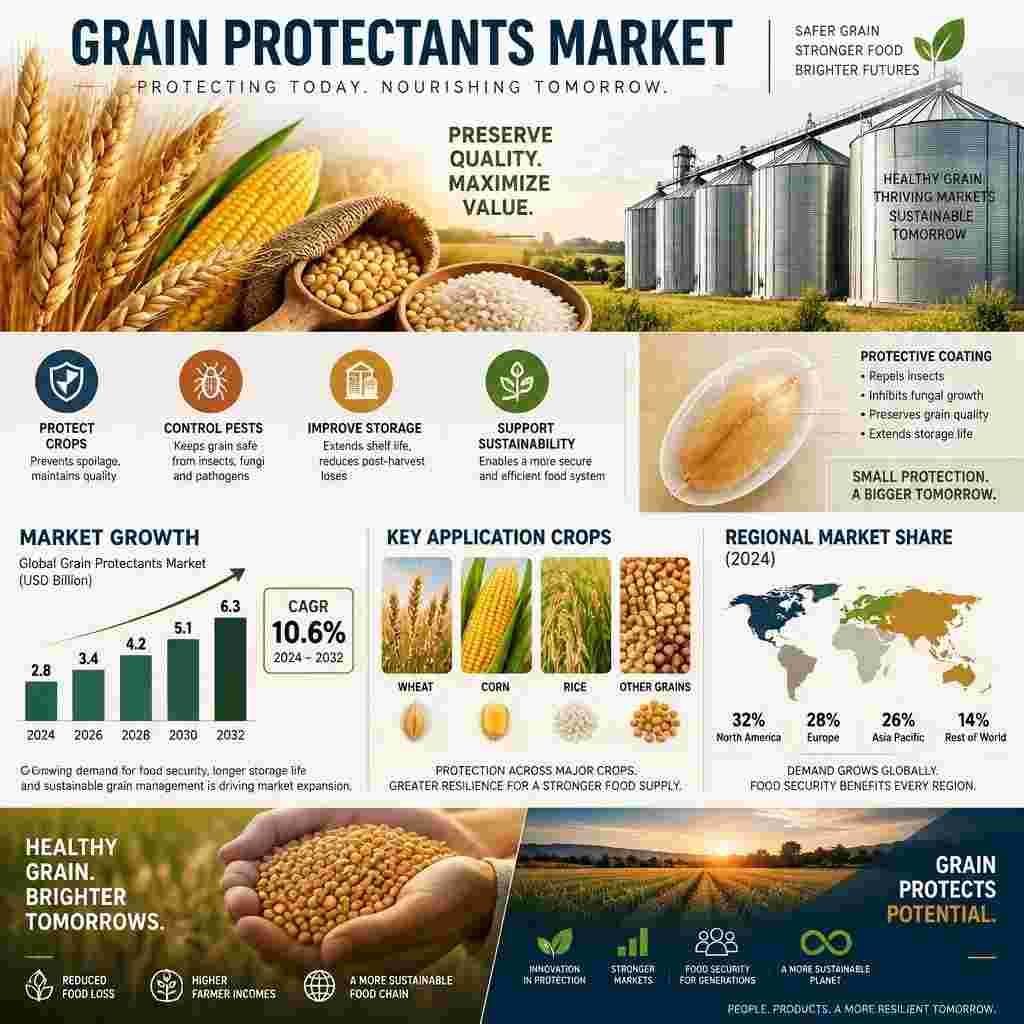
Introduction to the Grain Protectants Market
The Grain Protectants Market is an important segment of the agricultural chemicals and post-harvest management industries. Grain production does not end with harvesting because agricultural commodities must also be protected during storage, processing, transportation, and distribution. Insects and other storage-related threats can affect grain quality and create challenges for farmers, warehouse operators, food manufacturers, and animal feed producers. Effective grain protection is therefore an important consideration throughout the agricultural supply chain.
The increasing adoption of grain storage pest management and post-harvest protection products reflects the need for effective solutions that help preserve agricultural commodities. These products are designed to manage stored grain pests and support appropriate storage practices. Manufacturers are focusing on product formulations, application suitability, and protection methods that address different grain types and storage conditions. The growing importance of agricultural quality management is creating opportunities for businesses operating in this industry.
Increasing Importance of Post-Harvest Management
Post-harvest management plays an important role in maintaining agricultural product quality. After harvesting, grains may be exposed to several conditions that influence their quality and suitability for consumption or processing.
Insect infestation is one of the common challenges associated with grain storage. Certain insects can damage kernels, contaminate stored commodities, and create additional handling requirements.
Appropriate grain protection practices help storage operators address these challenges. These practices may include sanitation, regular inspection, suitable storage conditions, and the use of approved protectant products.
Effective post-harvest management also helps agricultural businesses maintain the quality of grain supplies intended for different markets.
Expansion of Grain Storage Infrastructure
The development of organized grain storage infrastructure is influencing the demand for protection solutions.
Warehouses, commercial storage facilities, grain processing units, and agricultural distribution centers require suitable pest management practices. Large storage operations must maintain appropriate environmental conditions while monitoring potential insect activity.
Storage operators increasingly recognize the importance of integrating protection measures into their facility management procedures.
Manufacturers can benefit from this development by offering products suitable for different storage environments and grain protection requirements.
Growing Demand for Food Quality Preservation
Food quality is an important consideration throughout the agricultural supply chain. Grain products are used in various food applications, making their preservation essential for processors and distributors.
Insect contamination and grain deterioration can create quality management challenges. Appropriate protection practices help reduce these risks when combined with proper storage management.
Food manufacturers also require raw materials that meet their quality and safety expectations. This encourages suppliers to pay greater attention to post-harvest handling and storage practices.
Grain protectants can contribute to these efforts as part of a comprehensive grain management strategy.
Role of Agricultural Pest Management
Agricultural pest management is an important factor supporting the development of the grain protectants industry.
Different insects can affect stored commodities depending on the grain type, storage environment, and geographical conditions.
Manufacturers develop different protection products to address specific pest management requirements. Product selection must consider approved applications, target pests, grain characteristics, and relevant safety instructions.
Integrated pest management is increasingly important because it combines preventive practices with suitable control methods.
Storage sanitation, inspection, monitoring, and responsible product application can help create a more effective approach to stored grain protection.
Innovation in Grain Protectant Products
Product innovation is creating opportunities for manufacturers in the grain protection industry.
Companies are exploring formulations designed to improve product suitability and support different storage requirements. Research and development activities can also help improve application compatibility and product handling.
There is increasing interest in alternative pest management approaches that complement conventional chemical products.
Manufacturers are also paying attention to product labeling, storage instructions, and application guidance to support responsible use.
These developments can help businesses address the changing needs of agricultural producers and commercial storage operators.
Challenges Affecting the Industry
The grain protectants industry faces challenges associated with regulatory compliance, product safety, pest resistance, and environmental considerations.
Manufacturers must ensure that their products comply with applicable agricultural chemical regulations.
Storage operators must follow approved instructions and appropriate safety procedures during product application.
Pest resistance is another important consideration. Integrated pest management practices can help reduce dependence on repeated use of a single control method.
Businesses must also consider changing customer expectations regarding food quality and environmentally responsible agricultural practices.
Future Industry Opportunities
The future development of the Grain Protectants Market will be influenced by agricultural commercialization, grain storage infrastructure, food quality requirements, and improvements in pest management technology.
Manufacturers can explore opportunities through specialized formulations, improved product application, and partnerships with agricultural distributors and storage businesses.
Companies that focus on responsible pest management and effective grain preservation can strengthen their position within the agricultural supply chain.
Frequently Asked Questions
Q1. What are the major factors driving the Grain Protectants Market?
Important factors include increasing attention to post-harvest management, commercial grain storage, agricultural development, food quality preservation, and stored grain pest management.
Q2. How do grain protectants help storage businesses?
Grain protectants support pest management in stored agricultural commodities and complement sanitation, inspection, and appropriate storage practices.

 English
 French
 Spanish
 Portuguese
 Deutsch
 Turkish
 Dutch
 Italiano
 Russian
 Romaian
 Portuguese (Brazil)
 Greek