


Introduction
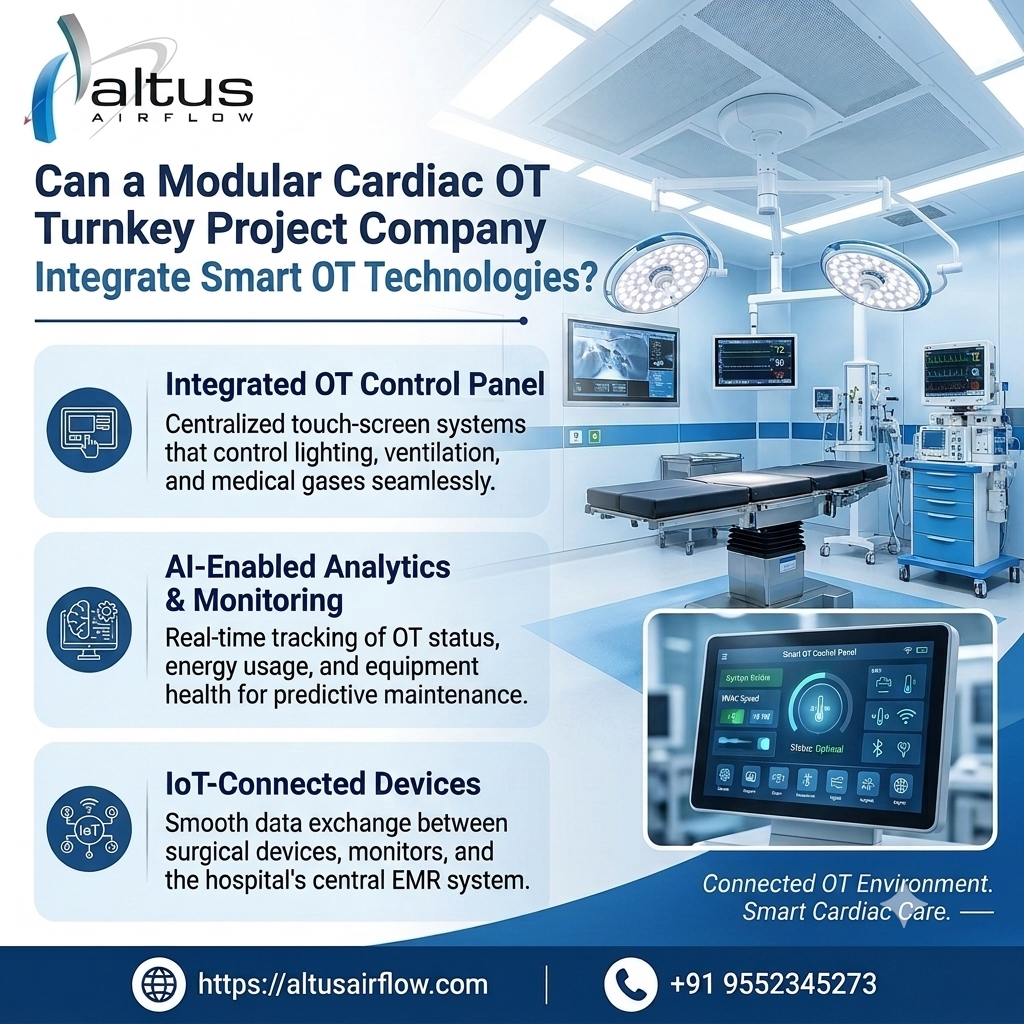
Altus Airflow understands that modern cardiac operating theatres require advanced infrastructure to support complex surgical procedures and efficient clinical workflows. A Modular Cardiac OT Turnkey Project Company can integrate smart OT technologies by combining digital monitoring systems, automated environmental controls, advanced surgical lighting, intelligent ventilation, and connected medical equipment. These technologies help hospitals improve operational coordination, maintain controlled surgical environments, and support medical professionals through reliable infrastructure.
Smart technology integration also requires careful planning, equipment compatibility, and coordination between architects, engineers, medical equipment suppliers, and healthcare professionals. A properly designed system ensures that different technologies operate together efficiently.
1. Understanding Smart OT Technologies in Cardiac Operating Theatres
Smart operating theatre technologies refer to advanced digital and automated systems that improve the management of surgical environments. These systems connect different medical devices, environmental controls, and monitoring platforms to create a coordinated operating theatre.
Cardiac surgeries require continuous monitoring, accurate equipment operation, and controlled environmental conditions. Smart technologies can support these requirements by providing real-time information and simplifying the management of essential systems.
Some commonly integrated smart OT technologies include:
-
Digital operating theatre management systems.
-
Automated HVAC and ventilation controls.
-
Intelligent surgical lighting.
-
Integrated patient monitoring systems.
-
Digital medical equipment connectivity.
-
Automated access control systems.
-
Real-time environmental monitoring.
-
Centralised alarm and control panels.
These technologies should be selected according to the hospital's clinical requirements, equipment specifications, and operational objectives.
2. Role of Turnkey Project Planning in Smart OT Integration
Integrating smart technologies requires more than installing advanced medical equipment. Every system must be planned and coordinated during the initial design and engineering stages.
A Modular Cardiac OT Turnkey Project Company can help coordinate different project components, including architectural planning, modular construction, electrical infrastructure, HVAC installation, and medical equipment integration.
The planning process generally involves several important activities.
Requirement assessment: The project team identifies the hospital's surgical requirements, existing infrastructure, and intended technology applications.
Technical planning: Engineers prepare layouts and technical drawings showing the positioning of equipment, electrical connections, control panels, and communication infrastructure.
System coordination: Different technology providers and consultants coordinate their requirements to avoid installation conflicts.
Infrastructure preparation: The modular OT is prepared with suitable electrical distribution, data connections, ventilation provisions, and equipment mounting arrangements.
Installation and integration: Smart systems are installed and connected according to approved technical specifications.
Testing and commissioning: Integrated systems are tested to verify their performance and compatibility before clinical use.
A structured planning process helps hospitals establish an operating theatre where different technologies work together effectively.
3. Integration of Smart HVAC and Environmental Monitoring Systems
Environmental control is one of the most important aspects of cardiac operating theatre infrastructure. Temperature, humidity, airflow, filtration, and pressure relationships must be maintained according to the applicable healthcare requirements.
Smart HVAC systems use sensors, controllers, and monitoring interfaces to manage environmental conditions.
Important features include:
Temperature monitoring: Digital sensors continuously measure room temperature and provide information to the HVAC control system.
Humidity monitoring: Monitoring devices help facility teams observe relative humidity and identify conditions outside the specified operating range.
Differential pressure monitoring: Pressure sensors monitor differences between the operating theatre and adjacent areas.
Airflow monitoring: Suitable sensors and control arrangements help assess ventilation performance.
Filter monitoring: Differential pressure across filtration stages can indicate when inspection or maintenance may be required.
Automated alerts: Monitoring systems can notify authorised personnel when environmental parameters move outside configured limits.
These features help facility managers monitor operating theatre conditions and respond to potential abnormalities.
4. Smart Surgical Lighting and Automated Control Systems
Surgical lighting is another important area where smart technologies can improve operating theatre functionality.
Modern LED surgical lights provide adjustable illumination, suitable colour rendering, and flexible positioning. Some advanced systems also offer electronic controls and integration with other operating theatre technologies.
Smart lighting features may include:
-
Adjustable illumination intensity.
-
Electronic brightness controls.
-
Colour temperature adjustment where supported.
-
Multiple light-head configurations.
-
Integrated camera systems in selected models.
-
Preset lighting configurations.
-
Remote or wall-mounted control interfaces.
These features allow medical professionals to adjust lighting according to procedural requirements.
Hospitals should also consider shadow management, lighting uniformity, heat generation, and compatibility with ceiling-mounted equipment.
Automated controls should be designed to remain accessible to clinical personnel without interrupting surgical activities.
5. Digital Operating Theatre Management Systems
Digital operating theatre management systems help connect different medical and technical devices through a centralised interface.
A properly integrated digital platform can provide medical professionals with access to relevant information from connected equipment.
A Modular Cardiac OT Turnkey Project Company can coordinate the infrastructure required for these systems during the project planning and installation stages.
Common digital OT capabilities include:
Centralised equipment control: Selected devices and room functions can be managed through a central interface, subject to equipment compatibility.
Video integration: Surgical cameras, displays, and compatible imaging systems can be connected to provide visual information within the operating theatre.
Digital documentation: Supported systems can assist with recording procedural information and managing relevant digital records.
Equipment status monitoring: Connected systems may display operational status and identify certain equipment faults.
Communication integration: Audio and video communication systems can support coordination between surgical teams and other hospital departments.
Data connectivity: Secure network infrastructure allows compatible devices and hospital systems to exchange information.
Hospitals should ensure that digital systems meet applicable data security, access control, and interoperability requirements.
6. Integration of Smart Medical Equipment and Patient Monitoring
Cardiac operating theatres use specialised medical devices that provide continuous information about the patient's condition.
Smart equipment integration can help medical professionals access information more efficiently and reduce the need to interact with multiple disconnected interfaces.
Important systems may include:
-
Multiparameter patient monitors.
-
Anaesthesia workstations.
-
Electrocardiography systems.
-
Haemodynamic monitoring equipment.
-
Surgical imaging systems.
-
Infusion pumps.
-
Defibrillators.
-
Other procedure-specific medical devices.
When compatible, these devices can connect with central monitoring or operating theatre management platforms.
However, hospitals should verify device compatibility, communication protocols, electrical requirements, and manufacturer specifications before integration.
Critical patient monitoring functions should remain reliable even if a central digital management platform becomes unavailable. Smart integration must support clinical workflows rather than introduce additional operational risks.
7. Role of Smart Access Control and Communication Systems
Operating theatre access management is important for maintaining hygiene, security, and organised movement within restricted clinical areas.
Smart access control systems can help hospitals manage authorised entry into designated operating theatre zones.
Common features include:
Electronic access cards: Authorised staff can enter restricted areas using approved access credentials.
Biometric identification: Selected systems use biometric verification for controlled access.
Door status monitoring: Digital interfaces can indicate whether designated doors are open or closed.
Interlocking arrangements: Where required by the design, selected doors can operate through coordinated controls to help maintain room conditions.
Communication panels: Integrated communication systems help staff coordinate activities between the operating theatre and supporting departments.
These systems should be designed with suitable emergency access arrangements and hospital security policies.
8. Importance of Electrical and Network Infrastructure
Smart operating theatre technologies depend on reliable electrical and communication infrastructure.
Before installing digital systems, hospitals should assess their electrical distribution, data connectivity, equipment loads, and backup power requirements.
A Modular Cardiac OT Turnkey Project Company should coordinate these infrastructure provisions with electrical consultants and technology suppliers.
Important requirements include:
Dedicated electrical circuits: Critical medical equipment may require appropriately designed dedicated electrical connections.
UPS integration: Suitable uninterruptible power supplies help maintain electrical continuity for designated critical equipment.
Emergency power: Generator-backed emergency distribution supports essential systems during extended utility outages.
Network connectivity: Structured cabling and secure network infrastructure support communication between compatible devices.
Earthing and electrical safety: Proper earthing, equipotential bonding, and protective devices are essential for medical electrical installations.
Cable management: Organised cable routing helps maintain accessibility, safety, and a clean operating environment.
Hospitals should also consider network redundancy, cybersecurity controls, and backup arrangements for important digital systems.
9. How Smart Technologies Improve Surgical Workflow?
Smart technology integration can improve coordination between surgical teams, equipment, and hospital departments.
When different systems are appropriately connected, medical professionals can access relevant information through organised interfaces.
Some important workflow benefits include:
-
Better visibility of connected equipment status.
-
Easier access to compatible surgical imaging systems.
-
Improved coordination between clinical teams.
-
Simplified monitoring of environmental conditions.
-
More organised equipment management.
-
Faster identification of selected system abnormalities.
-
Better access to digital operational information.
For example, an integrated operating theatre display may allow authorised users to view information from compatible patient monitoring and imaging systems without switching between multiple independent displays.
The actual benefits depend on the selected technology, equipment compatibility, staff training, and implementation quality.
10. Testing and Commissioning of Smart OT Technologies
Installing smart technologies does not automatically guarantee reliable performance. All integrated systems should undergo appropriate testing before the operating theatre is used for clinical procedures.
Commissioning verifies that equipment, controls, and infrastructure operate according to approved specifications.
Important testing activities include:
-
HVAC testing: Verify airflow distribution, temperature, humidity, and pressure monitoring.
-
Electrical testing: Check electrical connections, protective devices, UPS systems, and emergency power arrangements.
-
Lighting testing: Verify illumination levels, brightness controls, and positioning mechanisms.
-
Network testing: Check communication between connected systems and confirm network reliability.
-
Equipment integration testing: Verify compatibility and communication between selected medical devices.
-
Alarm testing: Confirm that configured alerts and notifications operate correctly.
-
Access control testing: Check electronic entry systems and emergency access functions.
-
Operational testing: Allow relevant clinical and technical teams to evaluate system functionality.
Hospitals should maintain commissioning reports, equipment documentation, and maintenance records for future reference.
11. Staff Training and Ongoing Technical Support
Smart OT technologies are useful only when healthcare professionals and facility teams understand how to operate them.
Hospitals should arrange training sessions for surgeons, nurses, technicians, biomedical engineers, and facility management personnel.
Training should cover:
-
Operation of digital OT control panels.
-
Use of integrated surgical displays.
-
Adjustment of smart lighting systems.
-
Monitoring HVAC parameters.
-
Understanding equipment alerts.
-
Basic troubleshooting procedures.
-
Emergency operating arrangements.
Technical support should also be available for software updates, equipment servicing, network maintenance, and system inspections.
Regular training helps staff use available features correctly and reduces operational difficulties during surgical procedures.
12. How to Select the Right Smart OT Integration Partner
Selecting an experienced project partner is essential for implementing smart operating theatre technologies successfully.
Hospitals should evaluate potential partners based on their technical knowledge, healthcare infrastructure experience, and ability to coordinate multiple systems.
Important selection criteria include:
-
Experience in modular operating theatre projects.
-
Knowledge of healthcare ventilation systems.
-
Understanding of medical electrical infrastructure.
-
Experience coordinating digital equipment integration.
-
Availability of technical drawings and documentation.
-
Ability to manage installation and commissioning.
-
Coordination with architects and medical equipment suppliers.
-
Availability of after-installation support.
Hospitals should also review previous project references and evaluate whether the proposed solutions meet their specific clinical and engineering requirements.
Conclusion
Smart OT technologies can significantly improve the functionality and coordination of modern cardiac operating theatres. Digital management systems, automated HVAC controls, intelligent surgical lighting, connected medical equipment, access control, and real-time environmental monitoring help create an organised surgical environment. Successful integration depends on detailed planning, compatible equipment, reliable electrical and network infrastructure, and comprehensive commissioning.
A properly designed Modular Cardiac OT Turnkey Project Company approach helps hospitals coordinate these technologies with modular construction and essential healthcare infrastructure.
Altus Airflow focuses on specialised modular healthcare infrastructure, supporting hospitals with coordinated planning, engineering, ventilation integration, and operating theatre development. Through attention to technical specifications and project execution, Altus Airflow helps create functional and technology-ready surgical environments.
Frequently Asked Questions (FAQs)
1. Can a Modular Cardiac OT Turnkey Project Company integrate smart OT technologies?
Yes. A Modular Cardiac OT Turnkey Project Company can coordinate digital management systems, smart HVAC controls, surgical lighting, patient monitoring, and connected medical equipment.
2. What are smart OT technologies?
They are digital and automated systems that improve operating theatre monitoring, equipment management, and clinical coordination.
3. Can HVAC systems be integrated with smart monitoring?
Yes. Sensors and controllers can monitor temperature, humidity, airflow, and differential pressure.
4. What is the role of digital OT management systems?
They connect compatible medical devices, displays, and control systems through a centralised interface.
5. Are smart surgical lights useful in cardiac operating theatres?
Yes. They offer adjustable illumination and other features that support surgical visibility.
Read Our Previous Blog ---------------> How does a Modular Cardiac OT Setup Company test laminar airflow performance?

 English
 Arabic
 French
 Spanish
 Portuguese
 Turkish
 Dutch
 Italiano
 Russian
 Romaian
 Portuguese (Brazil)
 Greek