


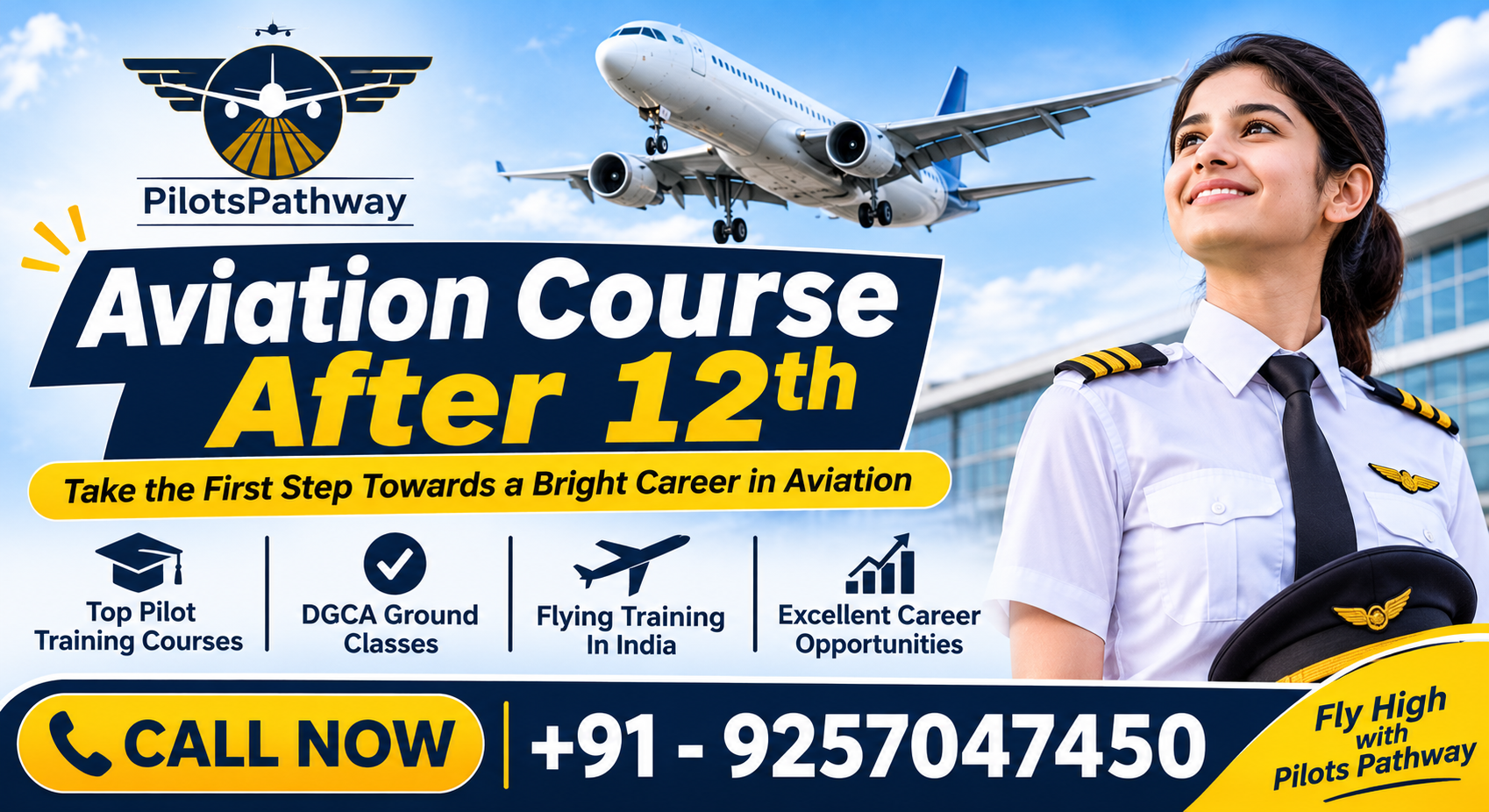
Finishing Class 12 is a big moment in every student's life, because it is the time when you decide what to do next. If you love aeroplanes, travel, and the idea of working in a field that is full of responsibility and respect, then an aviation course after 12th can be a wonderful choice. Aviation is not only about flying. It includes many careers, and each one needs proper training. In this blog, we explain the options in simple words, talk about commercial pilot course fees, describe PPL training in India, look at the Air India cadet pilot program, and show how Pilots Pathway can guide you in the right direction.
Why Choose an Aviation Course After 12th?
India has one of the fastest growing aviation industries in the world. More people are travelling by air every year, airlines are adding new aircraft, and airports are being built or expanded in many cities. This growth creates a steady need for trained people, from pilots and cabin crew to engineers, ground staff, and air traffic professionals. An aviation course after 12th lets you enter this field at an early age, so you can build skills and experience while many of your friends are still studying general subjects.
Another reason to choose aviation is the variety of careers it offers. If you enjoy mathematics and physics, you can think about becoming a pilot or an aircraft maintenance engineer. If you are good at communication and love meeting people, cabin crew or airport customer service may suit you. If you like planning and working with technology, you can look at air traffic control or airline operations. The key is to understand each path, check the eligibility rules, and choose the one that fits your interest, health, and budget.
Career Options in Aviation After Class 12
The most popular choice for many students is becoming a pilot. To do this, you need to complete Class 12 with physics and mathematics, pass a medical examination, and complete training approved by the Directorate General of Civil Aviation, known as the DGCA. Pilots can work for airlines, cargo companies, charter services, and flying schools, and the career offers a strong salary and a high level of respect.
Another option is aircraft maintenance engineering, where you learn how to inspect, repair, and keep aircraft safe for flying. Cabin crew is a good choice for students who like service, travel, and teamwork. Students can also study airport management, aviation hospitality, or ground handling. Each of these needs a different type of course, so you should read the details carefully before you decide. If you are serious about becoming a pilot, the sections below explain what you must know, including the cost, the license stages, and the choice of a good school.
Understanding Commercial Pilot Course Fees
One of the first questions students and parents ask is about commercial pilot course fees. A Commercial Pilot License, or CPL, is the license that lets you fly professionally, and the training is a large financial commitment. The total cost is not a single payment. It includes ground classes, flying hours, simulator sessions, medical tests, exam charges, license fees, and often living costs during the training period.
The fees differ from one school to another because of many reasons. The type and age of the training aircraft, the location of the school, the weather, the number of instructors, and the number of flying hours you need all change the final amount. A student who learns quickly may finish close to the minimum hours, while another student may need extra practice, which increases the cost. This is why you should never choose a school only because its advertised price is low. Always ask for a written fee breakdown that clearly shows what is included and what is extra, and keep some savings aside for unexpected costs. Many families also use education loans, but it is important to understand the repayment terms before taking one.
PPL Training in India: The First Step
Many students begin their flying journey with a Private Pilot License. PPL training in India is a smart starting point because it teaches the basics of flying and helps you find out whether aviation is truly right for you. A PPL allows you to fly an aircraft for personal use, but not for paid work. Under DGCA rules, you must be at least 17 years old, and you need to complete a minimum of 40 hours of flying.
During this stage, you learn how to take off, land, turn, climb, navigate, use the radio, and handle simple emergencies. You also study ground subjects such as air regulations and navigation. Good PPL training in India builds confidence and discipline, and it creates a strong base for later training. Students who go on to the commercial license can often use the experience gained in their PPL, so the time and effort are not wasted. For many students, a PPL is also a safe way to test their interest before they commit to the full cost of a commercial license.
The Air India Cadet Pilot Program
Another path that attracts many students is the Air India cadet pilot program. A cadet program is a structure in which an airline selects candidates and trains them to become pilots for that airline. The selection process usually includes written tests, aptitude checks, interviews, and medical examinations. Chosen candidates then follow an approved training plan, which gives them a clearer route from the classroom to the cockpit.
The biggest benefit of the Air India cadet pilot program is that it offers a defined path toward a flying career with a well-known airline. However, the number of seats is limited, and many students apply, so competition is strong. Because rules, fees, and eligibility can change from time to time, you should always check the latest details on the official Air India website before applying. To improve your chances, work on your mathematics, physics, and English, stay physically fit, and practise for interviews. It is also wise to keep other options open, so that your career does not depend on a single selection.
Why DGCA Approved Pilot Training Is Important
Before you pay any fee, you must make sure the school offers DGCA Approved Pilot Training. The DGCA is the authority that controls civil aviation in India, and it decides which schools can train students and issue licenses under its rules. If your training does not follow these rules, your flying hours may not be accepted when you apply for your license, and this can waste both your time and your money.
You can ask the school to show proof of approval, and you can also confirm it through the official DGCA website. Look at the aircraft used, the qualification of the instructors, and the quality of the ground classes. A school that is open about these details shows that it respects its students. Choosing DGCA Approved Pilot Training protects your investment and gives you the confidence that each hour of study and flying is moving you closer to a valid license.
How to Find the Best Pilot Training in India
Many students search for the best pilot training in india, but the best school is not always the biggest or the most expensive one. The best school for you is the one that follows DGCA rules, has qualified instructors, offers enough flying slots, gives honest advice about costs, and supports you until you finish. It is helpful to visit the school if you can, speak with students who are already training, and ask how long the average student takes to complete the course.
When you compare options for the best pilot training in india, pay attention to the quality of teaching, the condition of the aircraft, the size of each batch, and the help given for airline interviews after training. Be careful with any institute that promises guaranteed jobs or shows very low prices without clear proof. Honest training takes time and effort, and a good school will explain the real cost and the real timeline from the start.
How Pilots Pathway Supports Students
Pilots Pathway is a pilot training company based in India that helps students move through each stage of their aviation journey. Its courses include the Private Pilot License course, CPL ground training, CPL flight training, flight simulator sessions, airline preparation, a cadet pilot course, a foundation course, and DGCA ground classes. Having these options in one place makes it easier for a student to follow a clear plan rather than moving between different institutes.
A student who takes an aviation course after 12th with Pilots Pathway can begin with the foundation course to understand the basics, continue with ground classes to prepare for the DGCA exams, practise on a flight simulator, and then move on to flight training. Students who want to apply for airline selection can use the airline preparation classes and the cadet pilot course to get ready. If you have questions about commercial pilot course fees, the team at Pilots Pathway can explain the cost of each stage so that you and your family can plan with a clear mind.
Simple Tips for Students After Class 12
Success in aviation depends on good habits, so it helps to start early. First, study physics and mathematics with care, because these subjects are the base of pilot training. Second, take care of your health, since you must pass a medical examination and keep your medical certificate valid during your career. Third, practise English every day, because it is the language of aviation and clear communication is a vital part of flying safely.
Fourth, plan your budget well in advance and speak openly with your family about the cost of training. Finally, stay patient and disciplined. Aviation rewards students who respect rules, listen to their instructors, and keep learning, and this attitude will help you throughout your career.
Final Words
Choosing an aviation course after 12th is a big decision, but with clear information it becomes much easier. Understand the commercial pilot course fees, begin with PPL training in India if you want to test your interest, prepare well for the Air India cadet pilot program, and always choose DGCA Approved Pilot Training. Take time to find the best pilot training in india for your needs, and ask honest questions before you decide. With careful planning and the right guidance from Pilots Pathway, your dream of flying can become a real and successful career.

 English
 French
 Spanish
 Portuguese
 Deutsch
 Turkish
 Dutch
 Italiano
 Russian
 Romaian
 Portuguese (Brazil)
 Greek