


The deposit landed in ten seconds, but the withdrawal takes a working week â the asymmetry isn't a bug in the casino's banking stack, it's the visible edge of a review pipeline most players never see. Understanding where the days go separates the operators who are slow by design from those who are slow because the banking system itself is.
The pipeline behind the clock
A bank transfer withdrawal moves through four distinct stages, and only the final one is genuinely "banking". The first is the pending period â the operator's internal holding window, where a request sits in a queue before anyone touches it. Published terms checked against operators in August 2026 show this window ranging from a stated four hours at the efficient end to 48-72 hours at the cautious end, and it's the single biggest variable between two casinos using the same bank.
The second stage is verification clearance â documents checked before the first payout, and occasionally re-checked on large ones. The third is the batch cycle: many operators process bank transfers in daily or twice-daily runs, so a request approved at 23:00 may not leave until the next batch at noon. Only then does the SEPA transfer itself run â typically one to three business days inside the Eurozone.
The comparison of how operators stack these stages is documented at analystcasino.com/payments/bank-transfer, where the list is ranked on the payout handling rather than the deposit â the ordering that actually matters.
What the advertised numbers hide
The marketing page and the terms page tell different stories about the same withdrawal. "Fast payouts" on the homepage typically refers to the post-approval transfer leg only; the pending window and the batch cycle sit in the payments policy, sometimes in a different document entirely. An operator quoting "24-hour processing" is making a promise about its own desk, not about when the money arrives â and a 24-hour desk plus a weekend plus a two-day SEPA leg still lands on Wednesday.
The honest operators have started quoting the composite figure â total time from request to arrival â precisely because players learned to distrust the fragments. The contrast with e-wallets is instructive: a four-hour internal target at a wallet-friendly operator beats a "same-day" bank promise that omits the weekend gap.
Three figures worth checking before any withdrawal:
- The stated pending window, quoted in hours â the operator's own queue before anything moves.
- The batch schedule, usually daily at a fixed cut-off â a request just after the cut-off waits a full cycle.
- The withdrawal cap per transaction, which decides whether a large win comes as one payment or a series.

Where the operators diverge
The variance in processing targets across the sector is wider than the marketing suggests. Malta-licensed operators in particular cluster into two camps: those who built dedicated payments teams and publish aggressive targets, and those who treat withdrawals as a compliance back-office task.
| Operator trait | Typical pending window | Batch pattern | Practical floor |
|---|---|---|---|
| Dedicated payments desk | 4â24 hours | 2+ runs daily | Same-day SEPA possible |
| Standard back-office | 24â48 hours | Daily | 3â4 working days total |
| Cautious/compliance-led | 48â72 hours | Irregular | Up to 8 days on card routes |
The outliers are instructive both ways. Some operators have published card payout windows stretching to eight working days â a figure that reflects not banking latency but a deliberately conservative pending policy layered on top of card network settlement. At the other end, a stated four-hour processing target backed by a 24/7 payments team produces genuinely fast bank withdrawals when the SEPA leg cooperates.
The weekend multiplier nobody quotes
A withdrawal requested on Friday evening faces a compound delay that the terms never spell out: the pending window doesn't move over the weekend, the batch run doesn't fire, and the SEPA network itself pauses. A request that would clear by Wednesday if placed on Monday morning often doesn't arrive until the following Tuesday â a four-day penalty for the timing of the click.
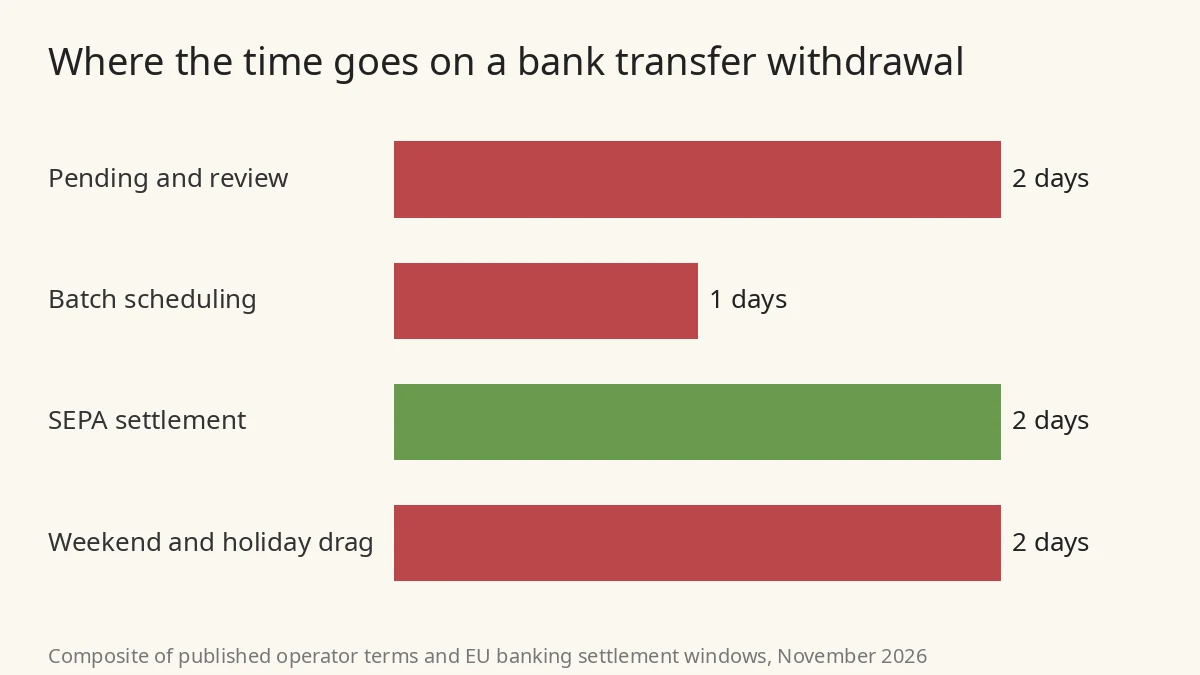
The composite â roughly a working week for the average case â explains why the bank transfer retains its reputation as the slow lane despite moving through an increasingly fast system. The money doesn't travel slowly; it waits.
The practical calculus for Irish players
Ireland sits inside the SEPA zone, so the transfer leg itself is as fast as the European system allows â the variable is entirely operator-side. Players who want predictable timing should look for three published commitments: a stated pending window rather than "as soon as possible", a named processing team schedule rather than an implied 24/7 desk, and withdrawal limits stated in euros rather than "on request".
The deeper comparison that matters for larger amounts sits with the monthly caps â several operators cap bank transfer withdrawals at levels like â¬30,000 per transaction, which is generous but not unlimited, and the caps interact with the pending queue in ways that turn a jackpot into a schedule. The full methodology is on the Central Bank of Ireland consumer guidance pages for payment services â worth five minutes before the first big withdrawal, not after.
Bank transfers will never be the fastest option, and they were never designed to be. They're the rail that carries the largest amounts, with the clearest audit trail, at the cost of patience â and the operators who respect that trade publish their pending windows plainly rather than hiding them behind "fast" banners.

 English
 French
 Spanish
 Portuguese
 Deutsch
 Turkish
 Dutch
 Italiano
 Russian
 Romaian
 Portuguese (Brazil)
 Greek