


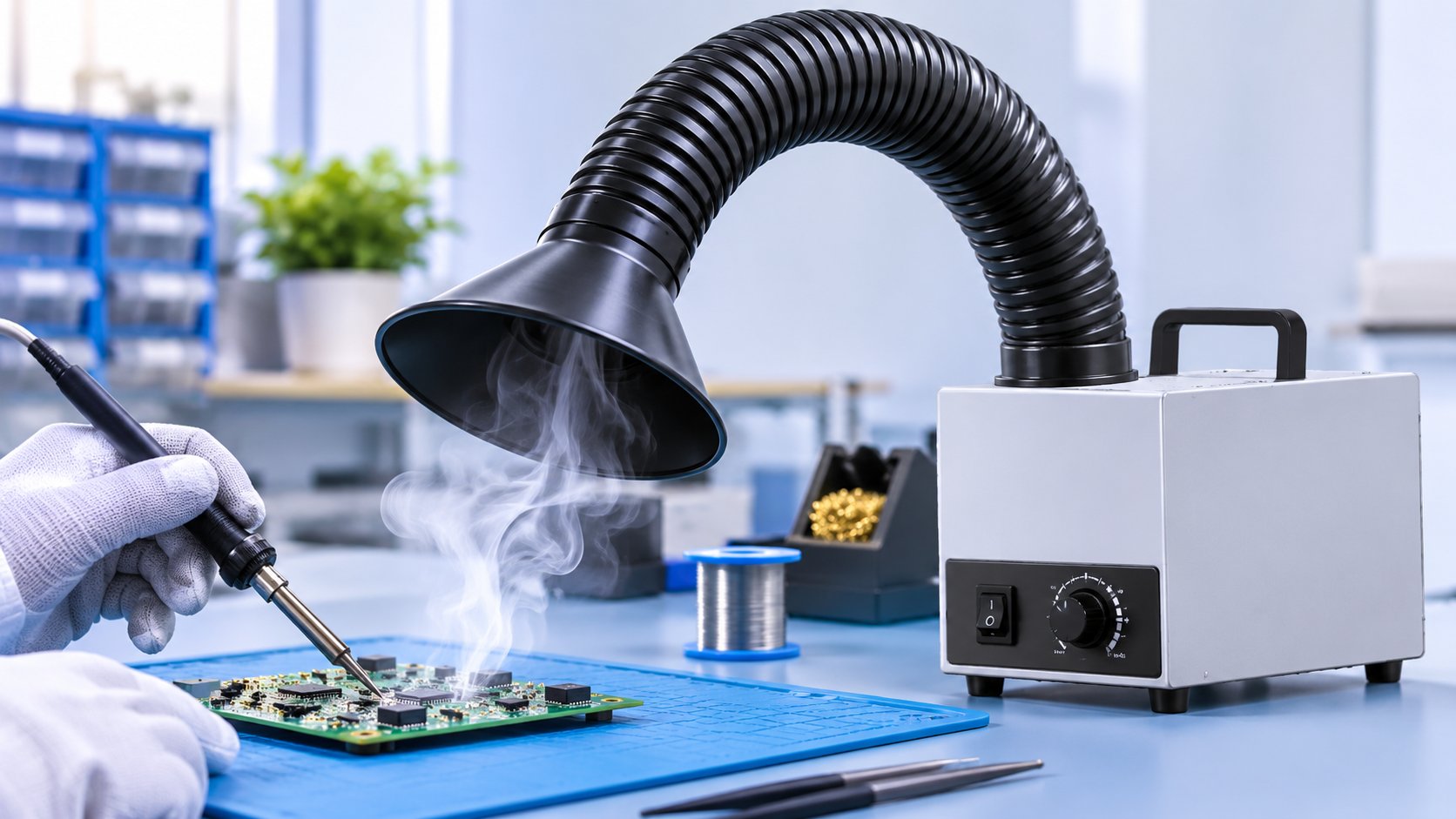
Workplace air quality is an important consideration in electronics manufacturing facilities. Processes such as soldering, PCB assembly, component replacement, and electronic repair can generate smoke and airborne contaminants. Without suitable control measures, these emissions may spread across production areas and affect the working environment.
A Fume Extractor is designed to capture airborne contaminants close to their source and pass the extracted air through an appropriate filtration or treatment system. When correctly selected, installed, and maintained, this equipment can support better air management in industrial workplaces.
For production managers and electronics manufacturing companies, understanding how extraction equipment works is essential for developing effective workplace safety practices.
Understanding Workplace Air Quality in Electronics Manufacturing
Electronics manufacturing involves various heating and assembly operations. During soldering, flux materials can release fumes containing airborne substances that may be harmful when inhaled.
The level of exposure depends on several factors, including the materials used, soldering temperature, operating duration, workstation design, and ventilation conditions.
A crowded production environment with several soldering stations may require a more comprehensive assessment than a small electronics repair workstation.
That is why air quality management should begin with identifying emission sources and understanding how contaminants move through the workplace.
How Fume Extractors Help Control Airborne Emissions
A Fume Extractor generally works by drawing contaminated air through an inlet positioned near the emission source.
The extracted air passes through a filtration arrangement designed to capture or adsorb specific contaminants. Depending on the equipment configuration, the treated air may be returned to the workspace or discharged through an appropriate exhaust system.
This approach is known as source capture or local exhaust ventilation when designed as part of a suitable ventilation arrangement.
Unlike ordinary fans, which mainly circulate air, source extraction is intended to capture contaminants before they disperse into the surrounding environment.
Major Benefits for Industrial Workstations
Better Control of Soldering Fumes
Soldering is one of the most common operations in electronics manufacturing. An appropriately positioned extraction inlet can capture emissions close to the soldering point.
Improved Operator Working Conditions
Reducing the spread of airborne contaminants can support a better working environment for operators who regularly perform soldering and rework activities.
Cleaner Production Areas
Effective source capture can help reduce the movement of airborne residues around production workstations.
Support for Workplace Safety Programs
Extraction equipment can form part of a broader workplace safety strategy that includes risk assessments, appropriate work practices, general ventilation, and operator training.
Adaptability Across Different Applications
Depending on the equipment design, extraction systems can be used in soldering stations, PCB repair areas, prototyping laboratories, and industrial electronics workstations.
Applications Where Air Extraction Is Important
Manual Soldering Stations: Regular soldering operations can generate flux fumes. Compact extraction systems with adjustable arms are commonly considered for individual stations.
PCB Rework Facilities: Component removal and replacement involve heating processes that may release airborne emissions.
BGA Repair Workstations: BGA rework equipment uses controlled heating to perform component-level repairs. Extraction requirements should be assessed according to the materials and process configuration.
Electronics Research Laboratories: Development teams frequently perform soldering, testing, and prototype modifications. Portable extraction systems may provide flexibility for changing workstations.
Industrial Assembly Units: Facilities with multiple production stations may need individual extractors or centralized ventilation systems based on a professional assessment.
5. Factors That Influence Extraction Effectiveness
Installing equipment does not automatically guarantee effective contaminant control. Several factors determine how well the system performs.
Capture Distance: The extraction inlet should be positioned as close as practical to the emission source without interfering with the work.
Airflow Design: Extraction capacity should match the capture hood, ducting, and operating conditions.
Filter Compatibility: The filtration arrangement must be appropriate for the type of particles, vapours, or gaseous contaminants generated.
Workstation Layout: Nearby fans, open doors, air-conditioning outlets, and cross-drafts can interfere with contaminant capture.
Maintenance: Filters and extraction components should be inspected according to manufacturer recommendations.
How to Improve Air Quality Alongside Fume Extraction
A Fume Extractor should be part of a complete air management strategy rather than the only safety measure.
Electronics manufacturers can improve their approach through several practical steps.
First, identify all operations that generate airborne emissions. Next, evaluate whether existing extraction equipment captures contaminants effectively.
Position capture hoods correctly and avoid placing them where airflow from fans or ventilation outlets can push fumes away from the inlet.
Establish a regular maintenance schedule and maintain records of filter replacement and equipment inspections.
Operator training is equally important. Employees should understand correct extraction positioning, equipment limitations, and procedures for reporting poor performance.
Where necessary, qualified ventilation professionals should evaluate airflow and exposure conditions to determine whether the existing system is adequate.
Choosing the Right Fume Extractor Supplier
Selecting a suitable supplier is an important part of equipment procurement.
When comparing Fume Extractor Manufacturers, review the product's filtration configuration, airflow specifications, maintenance requirements, operating noise, and replacement filter availability.
Companies searching for Fume Extractor Manufacturers in India should also examine technical documentation and the supplier's ability to support the intended industrial application.
Avoid selecting equipment only because it has a high advertised airflow figure. Actual performance depends on the complete extraction arrangement, including hood positioning, airflow resistance, and filter condition.
Reliable Spares & Consumables focuses on ESD protection products and industrial electronics tools. With 19 years of industry experience, we understand the practical requirements of electronics production and repair environments.
Explore our Fume Extractor range for equipment relevant to electronics manufacturing applications.
Conclusion
Maintaining workplace air quality requires attention to the materials, processes, and equipment used throughout electronics manufacturing.
A suitable Fume Extractor helps capture airborne contaminants at their source and supports a more controlled production environment.
By evaluating extraction capacity, filtration technology, workstation design, and maintenance requirements, manufacturers can make informed equipment decisions.
Effective fume management is an ongoing responsibility that combines appropriate equipment, correct operating practices, and regular performance checks.

 English
 Arabic
 French
 Spanish
 Deutsch
 Turkish
 Dutch
 Italiano
 Russian
 Romaian
 Portuguese (Brazil)
 Greek