


If you work at a desk, there is a good chance you know this feeling. It is around 2 p.m., your neck feels like a tight rope, your shoulders have crept up toward your ears, and a dull headache is settling in behind your eyes. You roll your neck, it cracks, and it helps for about ten minutes.
I spent years thinking this was just what a desk job felt like. It took me far too long to realize the pattern was trying to tell me something. This post is everything I wish someone had explained to me back then: what tech neck actually is, why it so often comes with headaches, what you can do at your desk today, and when it makes sense to see a chiropractor in Green Bay instead of just pushing through.
What "Tech Neck" Really Means
Tech neck, sometimes called text neck, is not a formal diagnosis. It is a nickname for a very common pattern: your head drifts forward, your shoulders round, and the muscles of your neck and upper back stay switched on all day just to hold your head up.
Your head is heavy. When it sits right over your shoulders, your spine stacks it fairly efficiently. When it drifts forward to look at a laptop or phone, the muscles at the back of your neck have to work harder to keep it from tipping further. Do that for eight hours, five days a week, and those muscles get tired, tight and sore.
The signs I learned to notice
In my experience, tech neck rarely shows up as one dramatic moment. It creeps in. These are the signs I started paying attention to:
- A stiff neck that is worse at the end of the workday
- Tightness across the tops of the shoulders
- Headaches that start at the base of the skull or wrap around the head
- Trouble turning your head fully, especially when checking a blind spot or backing out of the driveway
- Tingling or achiness that travels toward the shoulder blade
- Feeling like you need to crack your neck all the time
If you checked off three or more of those, you are in very good company. It is one of the most common reasons people look up a chiropractor in Green Bay.
Why Neck Tension and Headaches So Often Go Together
This was the part that clicked for me. The muscles at the top of the neck and base of the skull are closely tied to the head. When they stay tight for hours, many people feel that tension as a headache, often one that starts at the back and spreads forward.
That is why so many desk workers describe the same thing: the headache is not there in the morning, it shows up in the afternoon, and it hangs around for the rest of the day. It follows the posture, not the clock.
According to MedlinePlus, the National Library of Medicine's guide to neck pain, common everyday causes include sitting at a desk for long stretches without changing position, slouching while reading or watching TV, and having a computer monitor set too high or too low. That list could be a description of most office jobs.
A quick note on headaches that need medical care
Not every headache is a posture headache. If a headache comes on suddenly and severely, comes with fever and a stiff neck, follows a head injury, or comes with vision changes, confusion, weakness or trouble speaking, that needs medical attention right away. A good chiropractor will screen for these warning signs, but please do not wait on them.
What I Changed at My Desk First
Before anything else, I worked on my setup. These are the changes that made the biggest difference for me, and they cost almost nothing.
Raise the screen
Your monitor should sit roughly at eye level, so you look straight ahead rather than down. If you use a laptop, a stand plus a separate keyboard and mouse helps a lot. I used a stack of books for months before buying a stand, and it worked fine.
Bring the screen closer
If you lean forward to read, your head goes with you. Bump the font size up or move the screen closer so you can sit back.
Support your lower back
When your lower back slumps, your upper back rounds and your head drifts forward. A small cushion or rolled towel behind your lower back can help you sit tall without straining.
Keep your elbows close
Reaching forward for a keyboard or mouse pulls your shoulders forward too. Keep your elbows near your sides and the keyboard close.
Hold your phone higher
This one is simple but hard to remember. Lift the phone toward eye level instead of dropping your chin to your chest.
The Micro-Breaks That Actually Helped
Here is what I learned the hard way: the perfect desk setup still is not enough if you do not move. Your body is built to change positions. Staying perfectly still, even in "good" posture, gets uncomfortable.
I set a reminder every 30 to 45 minutes. When it goes off, I do one or two of these:
- Chin tucks. Sit tall and gently draw your chin straight back, like making a double chin. Hold for a few seconds and repeat five times.
- Shoulder rolls. Roll your shoulders up, back and down slowly, five to ten times.
- Gentle neck turns. Turn slowly to look over each shoulder, staying in a comfortable range.
- Doorway chest stretch. Place your forearms on a doorframe and gently lean forward to open the chest.
- Stand and walk. Even a trip to refill your water bottle resets your posture.
None of these should hurt. If a movement causes sharp pain, numbness or tingling, stop and get checked.
When Home Care Is Not Enough
Desk changes and stretches helped me a lot, but they did not fix everything. The neck still felt stuck in certain directions, and the afternoon headaches were less frequent but not gone. That is when I started looking at professional care.
Here is how I think about when it is time to see a chiropractor in Green Bay for neck pain and tech neck:
- You have tried setup changes and stretches for a few weeks without much change
- The stiffness keeps coming back, even after good days
- You cannot fully turn your head, and it is affecting driving or sleep
- Headaches are showing up several times a week
- You are relying on pain relievers more than you want to
- The tightness is spreading into your shoulders or between your shoulder blades
MedlinePlus also suggests contacting a provider if symptoms last more than a week with self-care, or if you have numbness, tingling or weakness in your arm or hand. Those are good guidelines to keep in mind.
What a Good Chiropractor Should Do for Tech Neck
Not every clinic approaches neck pain the same way. Based on my own experience and what I have seen with friends, here is what I think good care looks like.
Start with an assessment, not an adjustment
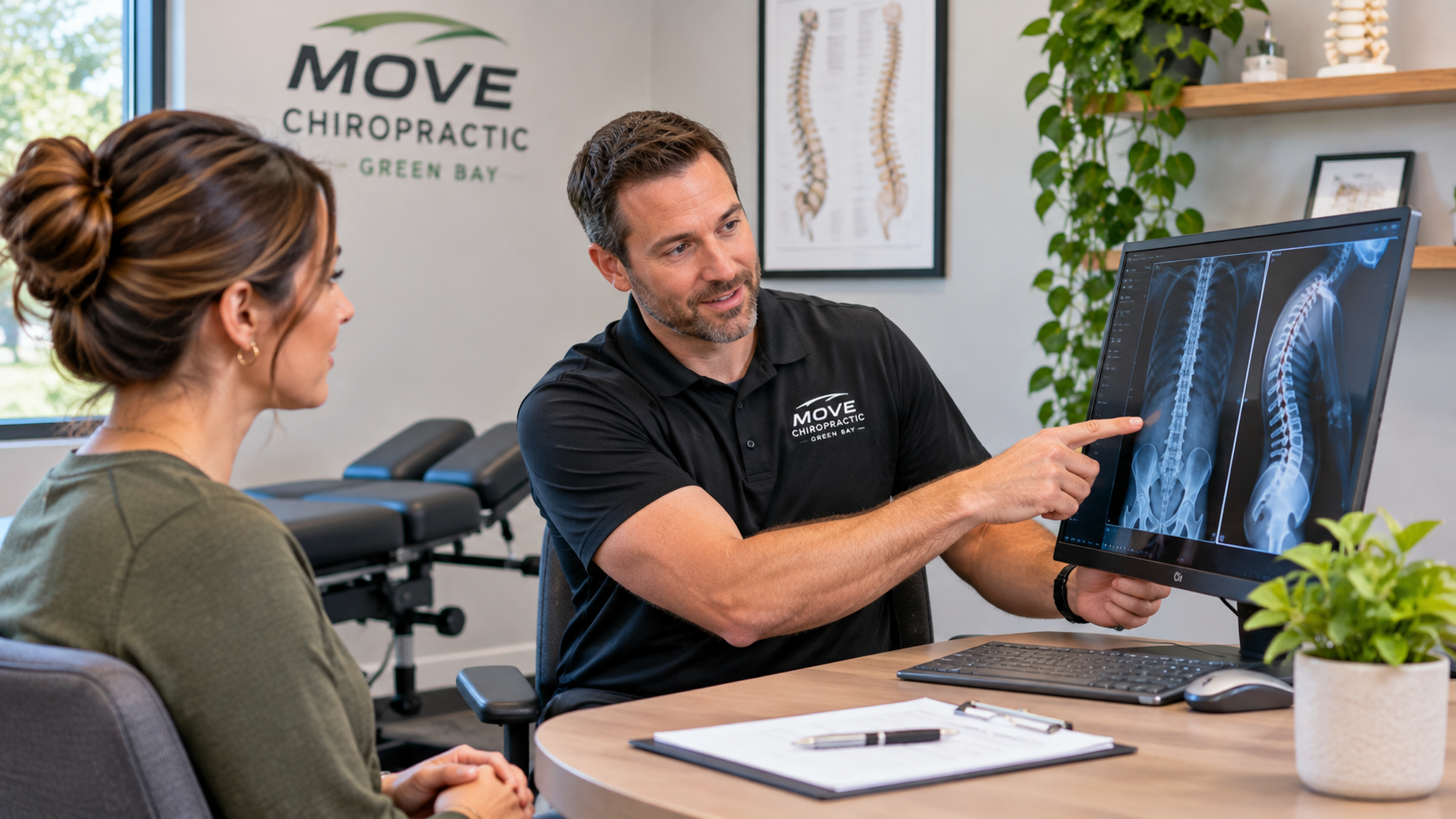
A thorough chiropractor in Green Bay should start by understanding your neck before treating it. That usually means a conversation about your work, your screen habits and your headache patterns, followed by a posture assessment and range of motion testing. Some clinics also use digital X-rays and muscle scans to see how your spine is stacking and how hard your supporting muscles are working.
The point is to find out why your neck is behaving the way it is, not just where it hurts.
Use more than one tool
The neck responds best, in my experience, when care includes a mix of approaches rather than a quick adjustment and a goodbye. One clinic that does this well is MOVE Chiropractic, which builds every visit around four steps, and I like how clearly the steps are explained. Their process starts with cervical traction and mobility work to open space in the neck and retrain how the spine moves, then a specific adjustment for stuck joints, and finally a vibration plate to help the body hold the change.
That kind of structure makes sense for tech neck because the problem is not just one stuck joint. It is a whole posture pattern that took years to build.
Track changes over time
This is the piece I value most. If your head sits forward today and your range of motion is limited, those should be measured and then retested on a schedule. When you can see your posture and movement numbers change alongside how you feel, you know the plan is working, or you know it needs to change.
Give you homework
A chiropractor who only treats you on the table is missing half the picture. Good care includes simple things you do at your desk and at home. For some people that includes a home support tool like a cervical curve support, when the exam shows it fits.
The Mistakes I Made (So You Do Not Have To)
I will be honest about where I went wrong, because I think a lot of people make the same mistakes.
I waited too long
I told myself it was just stress or just a long week for months. By the time I got checked, the pattern was well established. Earlier attention usually means an easier fix.
I only treated the symptom
Massage felt great for a day. Pain relievers took the edge off. But I was not changing anything about why my neck kept getting tight in the first place.
I cracked my own neck constantly
That twisting and popping felt like relief, but it did not change the underlying stiffness. If you feel the urge to crack your neck all day, that is a sign something is not moving well, and it is worth having a professional take a look.
I assumed good posture meant sitting still
The best posture is the next one. Moving often matters more than holding a perfect position.
I ignored my phone habits
I focused so much on my desk that I forgot I spent another two or three hours a day looking down at my phone. Fixing one without the other only got me halfway.
A Simple Daily Routine for Desk Workers
If I had to boil everything down into one routine, this is what I would hand to anyone with tech neck.
Morning:
- Five chin tucks and five slow neck turns before you check your phone
- A quick shoulder roll set while the coffee brews
At your desk:
- Screen at eye level, keyboard close, lower back supported
- A movement break every 30 to 45 minutes
- Phone held up, not down
Midday:
- A short walk at lunch, even 10 minutes
- Doorway chest stretch before the afternoon slump
Evening:
- A supportive pillow that keeps your neck in line with your spine
- Limit long phone sessions in bed, where your neck tends to bend the most
This routine will not fix everything on its own, but it is a solid foundation. Pair it with good care from a chiropractor in Green Bay and you give your neck the best chance to settle down.
Neck Pain Outside the Office: Driving, Sleeping and Screens at Home
Tech neck does not clock out when you do. Some of the biggest strain on my neck came from habits I never thought about at work.
In the car
If your neck is stiff, driving is often where you notice it first. Checking a blind spot, merging onto a busy road, or backing out of the driveway all ask your neck to rotate quickly. When rotation is limited, people tend to turn their whole upper body instead, which is awkward and can make you feel less confident on the road.
A few things helped me here. I adjusted my seat so I sat more upright with my head resting near the headrest instead of jutting forward. I set my mirrors after sitting tall, so slumping made them feel wrong. And I started paying attention to how far I could turn my head, because that became a simple way to notice whether my neck was improving or getting worse. If rotation is limited enough that it worries you while driving, that is a clear sign to get a proper assessment.
In bed
Sleep position matters more than most people think. Stomach sleeping usually means your head is turned to one side for hours, which can leave you stiff in the morning. Back or side sleeping tends to be easier on the neck.
The pillow should fill the space between your head and the mattress so your neck stays roughly in line with your spine. Too thick and your head tilts up; too thin and it drops down. I went through three pillows before finding one that worked, and it was worth the trial and error.
On the couch
This is the sneaky one. After a day at the desk, many of us spend the evening looking down at a phone or tablet on the couch, with our head bent even further forward than at work. I started propping the tablet on a pillow and holding my phone up, and it noticeably reduced how tight my neck felt the next morning.
What to Ask Before You Book
When you are ready to call a chiropractor in Green Bay about neck pain or headaches, a short phone call can tell you a lot. These are the questions I would ask:
- What does the first visit include? Listen for a history, posture assessment and range of motion testing.
- How do you approach neck pain specifically? A good answer mentions more than one tool.
- Do you screen for headache warning signs? You want a provider who knows when to refer out.
- How often do you re-test progress? Regular, scheduled re-checks are a good sign.
- Will you give me things to do at my desk? Home habits are a big part of tech neck care.
- Do I have to commit to a plan on the first day? The best answer is no.
If a chiropractor in Green Bay answers these clearly and without a sales pitch, that is usually a good indication of how the rest of the experience will go.
Why Green Bay Winters Make Tech Neck Worse
This might sound like a stretch, but hear me out. During a Northeast Wisconsin winter, most of us move less. We drive more instead of walking, we spend more time indoors on screens, and we hunch our shoulders against the cold every time we step outside. I notice my neck feels tighter from November to March almost every year.
Cold weather on its own does not cause neck pain, but the habits that come with it, like less movement, more sitting and tensed shoulders, add up. If you are noticing your neck pain gets worse in the colder months, that is a good time to double down on your desk routine and movement breaks.
How to Choose a Chiropractor in Green Bay for Neck Pain
If you have decided it is time to get help, here is what I would look for:
- A thorough first exam that includes posture and range of motion testing, not just a quick feel.
- Clear, plain-language findings so you understand what is going on.
- A structured visit that includes more than one approach, such as traction, mobility work and adjustments.
- Regular retesting so progress is measured, not guessed.
- No pressure to sign up for a long plan before you understand your results.
- Willingness to refer you out if your symptoms point to something that needs a medical doctor.
The right chiropractor in Green Bay will make you feel like a partner in your care, not just a patient on a schedule.
Stress Lives in the Neck Too
I do not want to make everything about posture, because stress plays a real role. When I am under pressure at work, I catch myself clenching my jaw, holding my breath and lifting my shoulders without noticing. By the end of a deadline week, my neck feels like concrete even if my desk setup has not changed at all.
That makes sense when you think about it. The muscles around your neck and shoulders react to tension, and if you never let them relax, they get tired and sore. A few habits helped me break that cycle:
- Check your shoulders. Several times a day, notice where your shoulders are. If they have crept up, let them drop.
- Unclench your jaw. Let your teeth part slightly and your tongue rest on the roof of your mouth.
- Breathe low. A few slow breaths into your belly, rather than your chest, can help the neck muscles settle.
- Protect your sleep. Poor sleep makes everything feel tighter and more sensitive the next day.
None of this replaces a proper assessment, but it gives your neck a fighting chance between visits. When I mentioned stress to my own chiropractor in Green Bay, they built it into the conversation about my plan instead of brushing it off, and that was one of the reasons I trusted them.
What Progress Can Look Like
I want to set realistic expectations, because I think that matters. In my experience, progress with tech neck is usually gradual. You might notice small things first: the afternoon headache comes later in the day, or it is lighter. Checking your blind spot gets a little easier. You realize you have not cracked your neck all morning.
Those small wins add up. What helps is having objective re-checks along the way, so you can see changes in posture and range of motion even on days when you do not feel your best. Bad days still happen, especially during busy work weeks. The goal is that they become less frequent and less intense over time.
My Bottom Line
Tech neck and afternoon headaches are not something you just have to accept because you work at a desk. Start with your setup and your habits, because those are free and they matter. Move often. Hold your phone up. And if the pattern keeps coming back after a few weeks of honest effort, get a proper assessment from a chiropractor in Green Bay who will measure what is going on and explain it in plain words.
Your neck carries your head all day, every day. It deserves a little attention before it starts demanding it.
Frequently Asked Questions
1. What is tech neck?
Tech neck, also called text neck, is a common nickname for neck and upper back strain caused by looking down at screens for long periods. Your head drifts forward, your shoulders round, and your neck muscles work harder all day to hold your head up.
2. Can a chiropractor in Green Bay help with tech neck?
Many people see a chiropractor for tech neck. A thorough chiropractor will assess your posture and range of motion, use approaches like traction, mobility work and adjustments, and give you habits to practice at your desk.
3. Why do I get headaches in the afternoon at work?
Many afternoon headaches line up with neck and shoulder tension that builds as you sit at a screen. If your headaches follow your workday rather than a set time, posture and muscle tension may be part of the picture.
4. How should my desk be set up to prevent neck pain?
Keep your monitor at eye level, bring the screen close enough that you do not lean forward, support your lower back, and keep your keyboard and mouse close to your body. Take a short movement break every 30 to 45 minutes.
5. Are neck stretches enough to fix tech neck?
Stretches like chin tucks, shoulder rolls and gentle neck turns can help a lot, especially with better desk habits. If stiffness and headaches keep coming back after a few weeks, a professional assessment can help find out why.
6. When should I see a doctor instead of a chiropractor for neck pain?
Get medical care right away if neck pain comes after an injury, comes with fever and a stiff neck, or comes with worsening numbness, weakness, trouble walking or loss of bladder or bowel control. A sudden, severe headache also needs urgent attention.
7. Is it bad to crack my own neck?
Occasional popping is common, but constantly needing to crack your neck usually means something is not moving well. It is worth having a professional look at why your neck keeps feeling stuck.
8. How long does it take to improve tech neck?
It varies from person to person. Progress is usually gradual, and regular re-checks of posture and range of motion help you see changes over time. Consistent habits at your desk make a big difference.
9. Does phone use cause neck pain?
Looking down at a phone for long periods puts your neck in a forward-bent position, which can add strain. Holding your phone closer to eye level and taking breaks can help.
10. What should I expect at my first visit for neck pain?
With a chiropractor in Green Bay, expect a conversation about your work, screen habits and symptoms, followed by a posture assessment and range of motion testing. Some clinics also use digital X-rays and muscle scans before explaining their findings and recommending a plan.

 English
 Arabic
 French
 Spanish
 Portuguese
 Turkish
 Dutch
 Italiano
 Russian
 Romaian
 Portuguese (Brazil)
 Greek